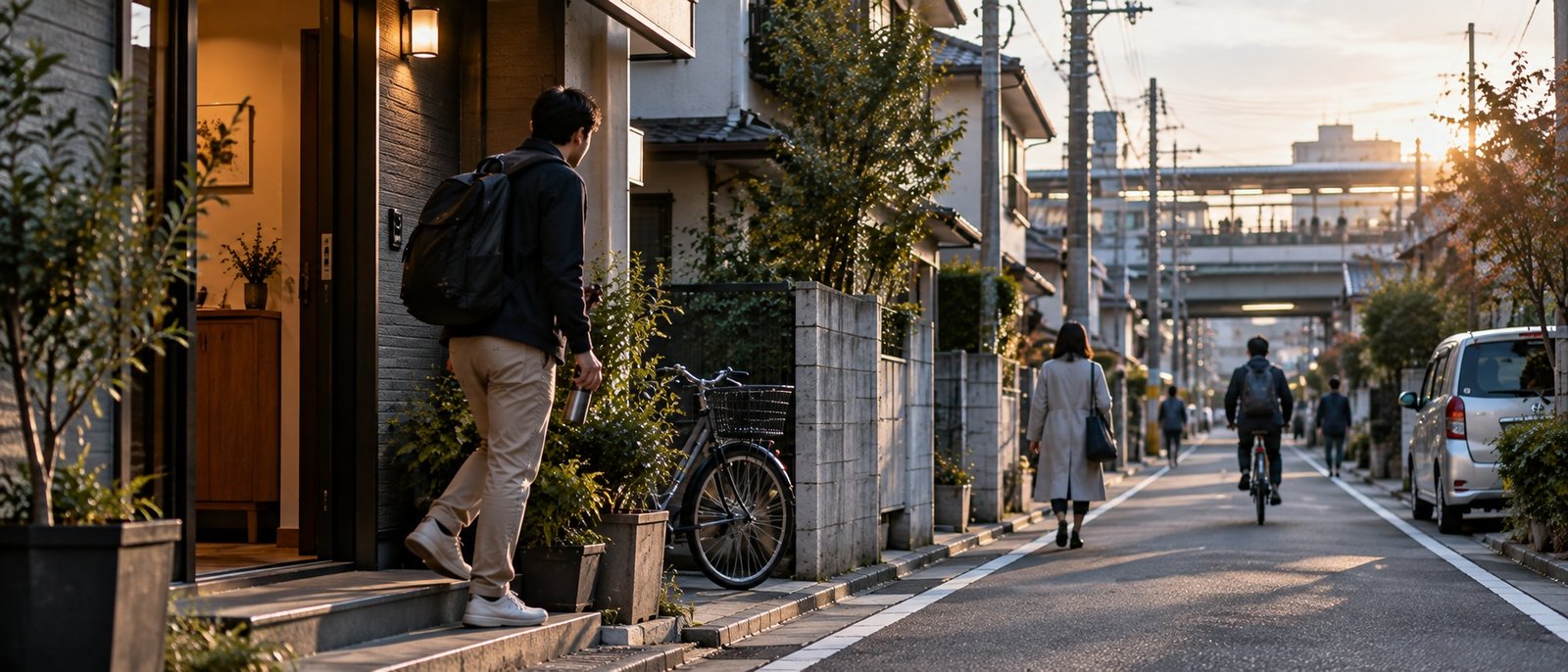
An ordinary Japanese neighbourhood beginning to move on a weekday morning
Foundation · Verbs & Actions

Now Japanese
Begins to Move.

Until now you have named people, places, time and things. Today Japanese begins doing something with them. Eat. Drink. Go. Read. Work. Return. A language starts to feel alive when it can follow an ordinary day.

01 · Meet the verb

Actions give the sentence a pulse.

A Japanese verb tells us what happens: somebody eats, goes, reads, works or studies. We begin with the polite ~ます forms because they are immediately useful in everyday conversation.

Thing / place + particle + verb
パンを 食たべます。
Pan o tabemasu.
駅えきへ 行いきます。
Eki e ikimasu.
東京とうきょうで 働はたらきます。
Tōkyō de hatarakimasu.
For now, learn these as useful complete verb forms. Dictionary forms and conjugation patterns can wait. Grammar has plenty of time to become complicated later.
02 · Your first action vocabulary

Thirteen verbs can describe a surprising amount of life.

食たべます tabemasu eat
飲のみます nomimasu drink
行いきます ikimasu go
来きます kimasu come
帰かえります kaerimasu return / go home
見みます mimasu see / watch
聞ききます kikimasu listen / hear
読よみます yomimasu read
書かきます kakimasu write
買かいます kaimasu buy
使つかいます tsukaimasu use
働はたらきます hatarakimasu work
勉強べんきょうします benkyō shimasu study
A quiet Japanese morning with breakfast, a drink and reading material
03 · Before the day properly begins

Breakfast already contains verbs.

Eat something. Drink something. Read something. Japanese does not need a dramatic situation to become useful.

朝あさごはんを 食たべます。 Asagohan o tabemasu. I eat breakfast.
コーヒーを 飲のみます。 Kōhī o nomimasu. I drink coffee.
毎日まいにち 本ほんを 読よみます。 Mainichi hon o yomimasu. I read books every day.
Verbs were already happening before breakfast. Japanese has simply started giving them names.
04 · を and the action

What receives the action?

With many verbs, を marks the thing the action acts on: what you eat, drink, watch, read, write, buy or use.

パンを食たべます。 Pan o tabemasu. I eat bread.
水みずを 飲のみます。 Mizu o nomimasu. I drink water.
テレビを見みます。 Terebi o mimasu. I watch television.
音楽おんがくを 聞ききます。 Ongaku o kikimasu. I listen to music.
本ほんを 読よみます。 Hon o yomimasu. I read a book.
名前なまえを 書かきます。 Namae o kakimasu. I write my name / a name.
05 · Go somewhere

駅えきへ 行いきます。

A verb can move the sentence through space. Here へ points toward the destination.
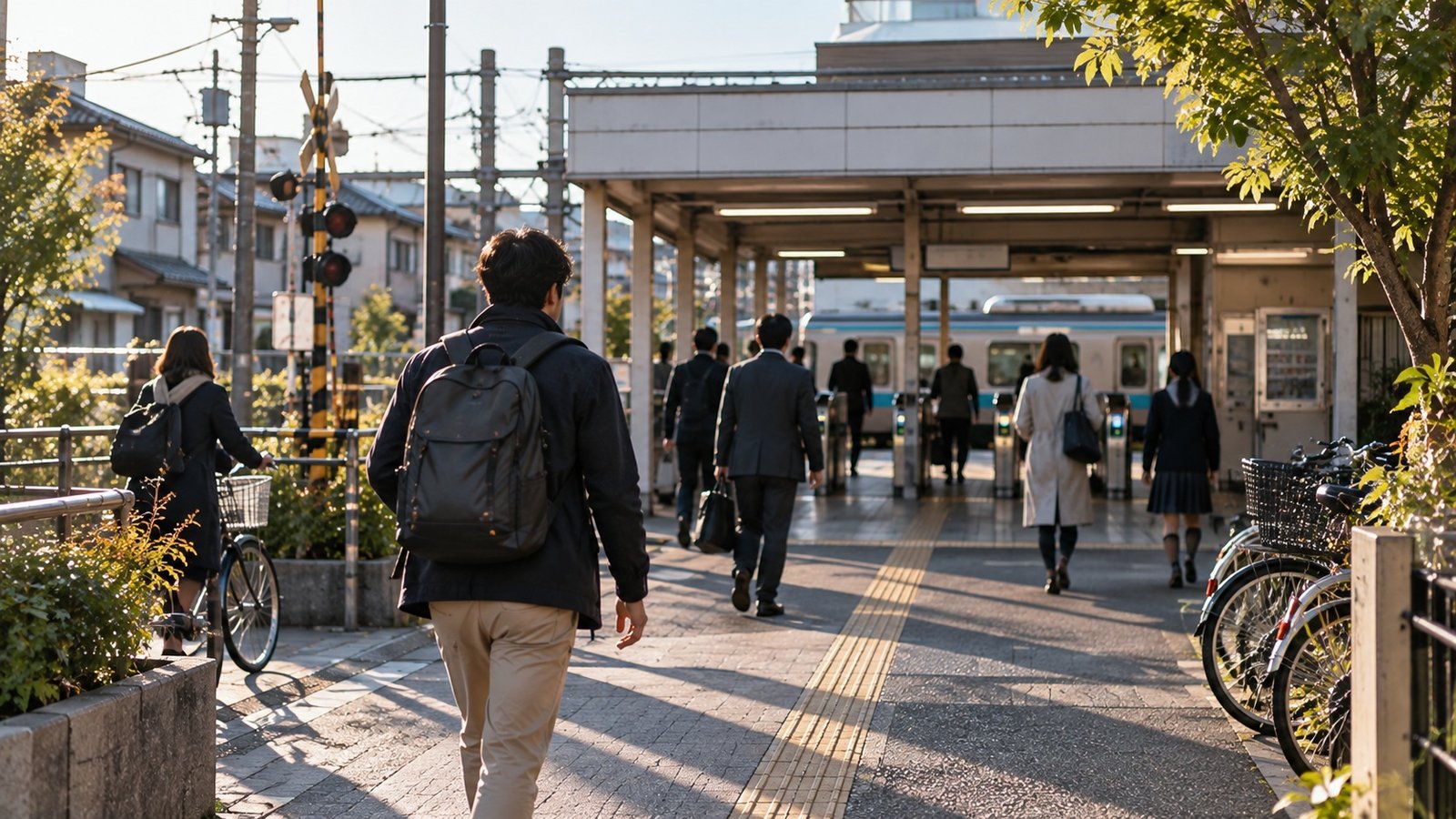
駅えきへ 行いきます。 Eki e ikimasu. I go to the station.
うちへ帰かえります。 Uchi e kaerimasu. I go home.
電車でんしゃで 行いきます。 Densha de ikimasu. I go by train.
The particle へ is written へ but pronounced e when it marks direction. Going somewhere is one of the first things a language must learn to do.
An adult walking toward an ordinary Japanese neighbourhood railway station
06 · Work, study, use

An ordinary afternoon has plenty to say.

パンを買かいます。 Pan o kaimasu. I buy bread.
パソコンを使つかいます。 Pasokon o tsukaimasu. I use a computer.
東京とうきょうで 働はたらきます。 Tōkyō de hatarakimasu. I work in Tokyo.
日本語にほんごを 勉強べんきょうします。 Nihongo o benkyō shimasu. I study Japanese.
うちで 日本語にほんごを 勉強べんきょうします。 Uchi de nihongo o benkyō shimasu. I study Japanese at home.
で can mark the place where an action happens: 東京とうきょうで 働はたらきます — work in Tokyo; うちで 勉強べんきょうします — study at home.
Adults reading, writing, studying and using computers in a quiet Japanese work or study space
07 · Japanese around the language

Most days are built from small verbs.

Work is rarely one heroic action. It is reading, writing, listening, using, studying, buying lunch, going somewhere and eventually going home.

本ほんを 読よみます。 Hon o yomimasu. I read a book.
名前なまえを 書かきます。 Namae o kakimasu. I write my name / a name.
パソコンを使つかいます。 Pasokon o tsukaimasu. I use a computer.
A few verbs can suddenly describe most of an ordinary afternoon. Not glamorous Japanese. Excellent Japanese.
08 · Ask somebody

何なにを 食たべますか。

Once there is another person in the sentence, vocabulary becomes conversation. 何を asks “what?” before an action.

何なにを 食たべますか。 Nani o tabemasu ka. What will you eat?
Woman Man
パンを食たべます。 Pan o tabemasu. I’ll eat bread.
Woman Man
何なにを 飲のみますか。 Nani o nomimasu ka. What will you drink?
Woman Man
コーヒーを飲のみます。 Kōhī o nomimasu. I’ll drink coffee.
Woman Man
09 · Hear a real exchange

Somebody is waiting for your answer.

Imagine the question across a café table or kitchen. You do not need a long speech. One useful verb is enough to keep the conversation moving.
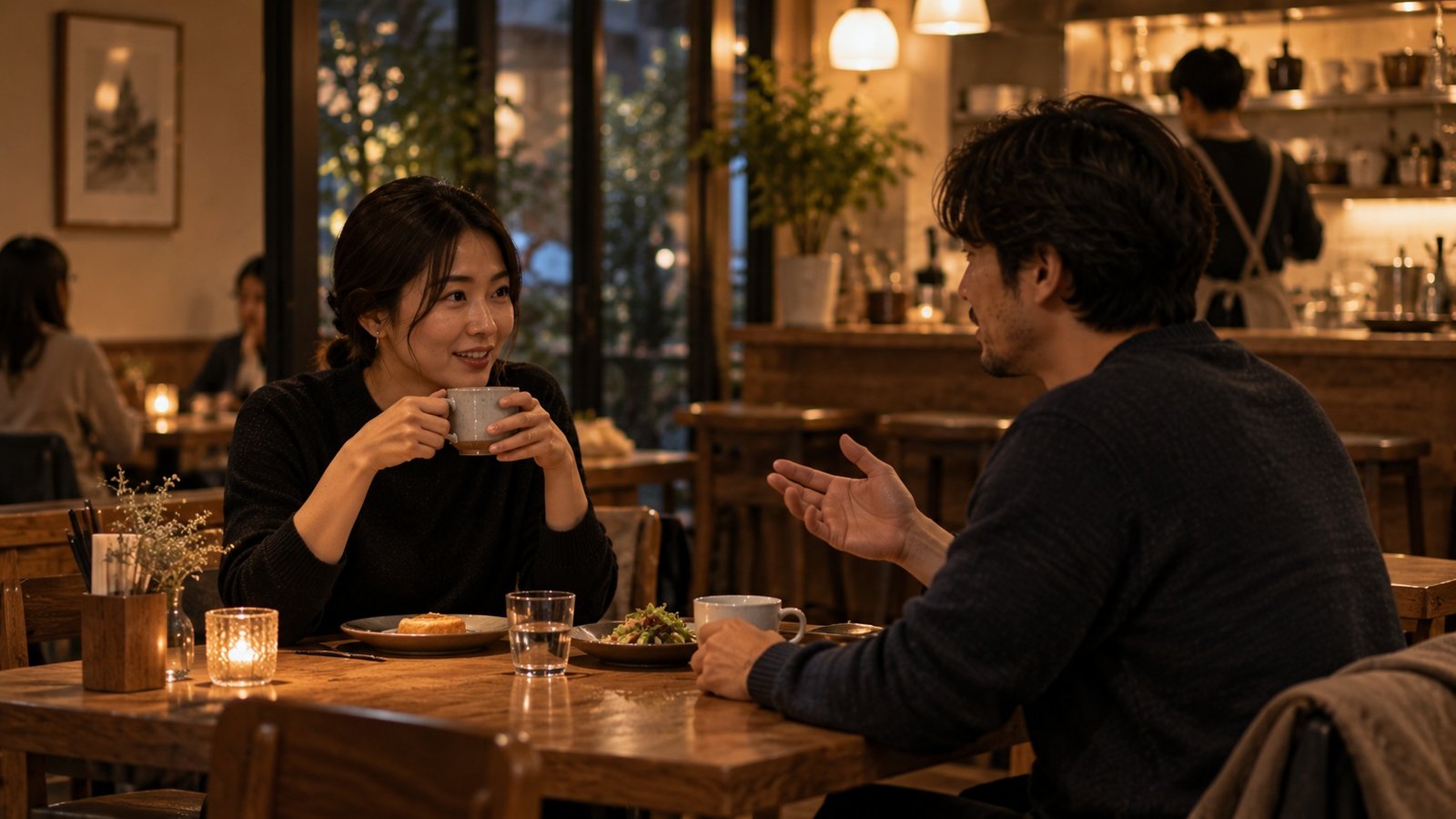
Grammar becomes conversation when somebody is waiting for your answer.
Two adults having a natural evening conversation over coffee and a simple meal
10 · Two more questions

Where are you going? What are you doing?

These two questions open enormous amounts of everyday Japanese. Listen first; the next lessons will develop the patterns further.

どこへ行いきますか。 Doko e ikimasu ka. Where are you going?
Man
駅えきへ 行いきます。 Eki e ikimasu. I’m going to the station.
Man
何なにをしますか。 Nani o shimasu ka. What will you do?
Man
日本語にほんごを 勉強べんきょうします。 Nihongo o benkyō shimasu. I’ll study Japanese.
Man
11 · Speak

Build your own ordinary day.

Choose one item from each part of the day and say the sentence aloud. Keep it simple enough that you can actually use it.

Morning

朝あさごはんを 食たべます。 Asagohan o tabemasu. · I eat breakfast.
コーヒーを飲のみます。 Kōhī o nomimasu. · I drink coffee.

Day

東京とうきょうで 働はたらきます。 Tōkyō de hatarakimasu. · I work in Tokyo.
日本語にほんごを 勉強べんきょうします。 Nihongo o benkyō shimasu. · I study Japanese.

Evening

本ほんを 読よみます。 Hon o yomimasu. · I read a book.
うちへ帰かえります。 Uchi e kaerimasu. · I go home.
12 · What did you notice?

The sentence now has somewhere to go.

You already knew nouns and several particles. Verbs turn those pieces into events.

を

marks many things acted upon.

本ほんを 読よみます。 Hon o yomimasu. · I read a book.
へ

points toward a destination.

駅えきへ 行いきます。 Eki e ikimasu. · I go to the station.
で

can mark where an action happens.

東京とうきょうで 働はたらきます。 Tōkyō de hatarakimasu. · I work in Tokyo.
You do not need to master every use of these particles today. The goal is to see familiar pieces beginning to work together around a verb.
13 · Real Japan mission

Follow six verbs through one day.

Tomorrow, notice six ordinary actions as they happen. Eat. Drink. Go. Use. Read. Return. Say the Japanese verb quietly when the action appears.

Notice

Do not manufacture a study situation. Let ordinary life provide one.

Say

食たべます tabemasu · eat
飲のみます nomimasu · drink
行いきます ikimasu · go
読よみます yomimasu · read

Connect

水みずを 飲のみます。 Mizu o nomimasu. · I drink water.
駅えきへ 行いきます。 Eki e ikimasu. · I go to the station.
An ordinary Japanese neighbourhood at blue hour with people returning home and warm windows
14 · Continue your journey

A language begins to live
when things start happening.

Eat. Drink. Go. Work. Read. Return. None of these actions is extraordinary. That is precisely why they matter. Japanese is beginning to follow you through an ordinary day—and ordinary days are where most of life has been hiding.