Sometimes Language Is
Asking Someone to Help.
Until now, Japanese has helped you describe your world. Now it begins to help you reach another person.
A familiar form.
A new human purpose.
You already know the て-form. Add ください, and an action can become a simple polite request.
Look. Listen. Wait.
Write. Read. Go. Show.
These are small phrases, but they appear everywhere: lessons, counters, stations, offices, shops and ordinary conversations.

The action is familiar.
The relationship changes.
Now the sentence is directed toward another person.
A form. A counter.
A moment of waiting.
You do not have to
understand everything.
Two requests can rescue an entire conversation.

Show. Wait. Come.
Read. Write.
In everyday encounters, beginning with すみません can help open the interaction naturally: “Excuse me...” before the request itself.
Sometimes a few words
are enough.
You do not need a long sentence to keep an ordinary interaction moving.

A small request can
help you continue.
Useful does not mean universal.
〜てください is an important Foundation request pattern. In real Japanese, speakers may choose softer or more indirect forms depending on the relationship and situation. Those distinctions come later. For now, learn to recognize this pattern and use it in clear, appropriate everyday situations.
Someone asks.
Someone answers.
Ask.
Listen.
Continue.
A request is successful when another person can respond to it. Listen to four small interactions.
Japanese is no longer
only something you study.
You can ask where something is. You can ask someone to repeat themselves. You can ask them to speak slowly. You can understand a simple request directed toward you.
These are small exchanges. But small exchanges are how a language begins becoming part of ordinary life.
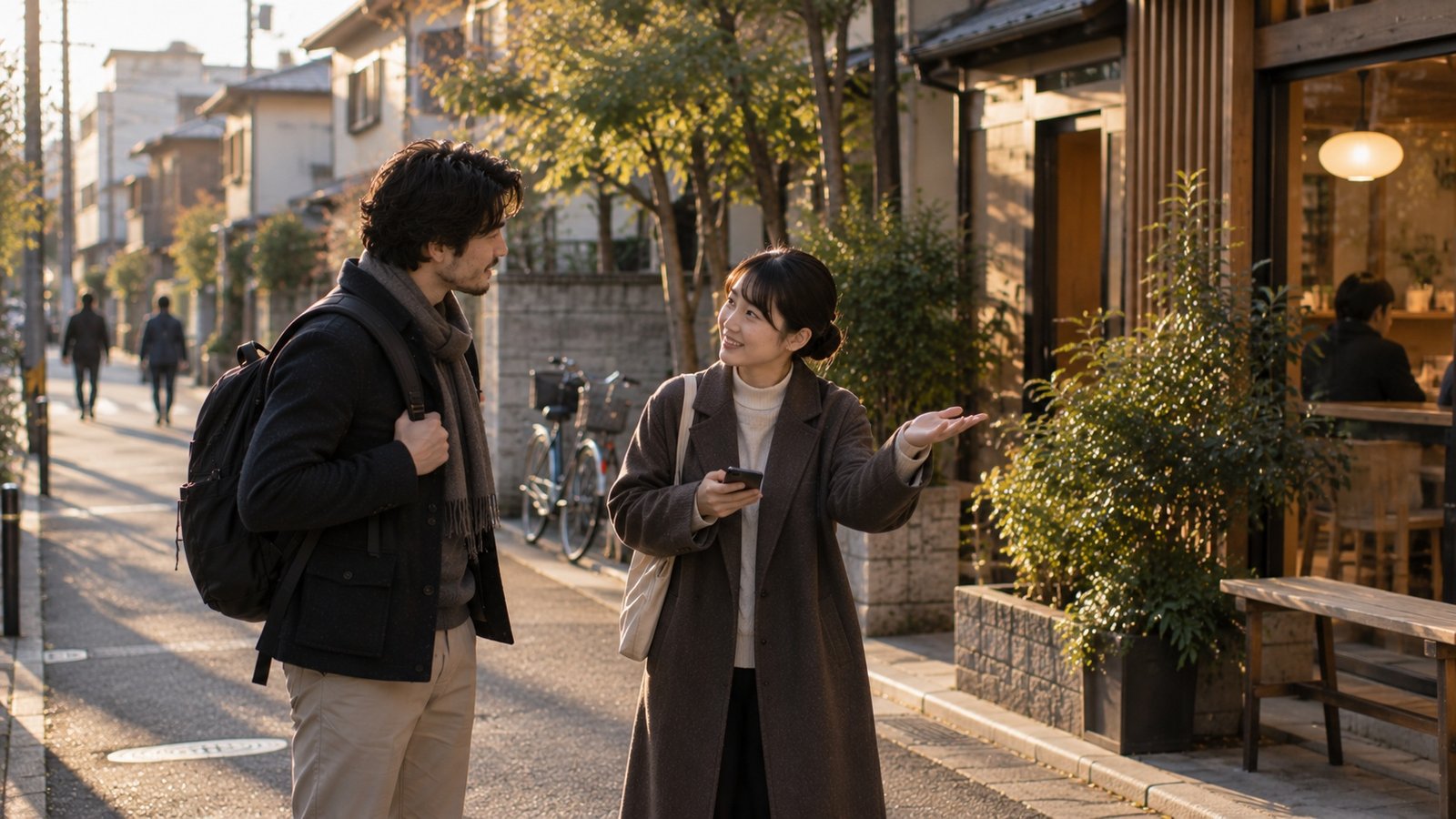
“At first Japanese was something on the page. Now it can begin something between two people.”
The goal was never to collect isolated sentences. It was to build enough structure that ordinary Japan could begin answering back.
Look at what you can
now build around a verb.
Each lesson added another piece. Those pieces can now combine rather than live as separate grammar points.
Keep one conversation
from ending.
The next time Japanese moves too quickly, do not disappear from the conversation. Try one small request.
Success is not understanding every word. Sometimes success is simply knowing how to keep the interaction alive.
Foundation Was Never
the Destination.
You can ask. You can answer. You can describe. You can listen. You can try again.
Foundation was the moment Japan began answering back.