A Tiny Pause
Changes Everything.
Japanese is about to teach you something wonderfully strange: sometimes the important sound is the moment when you do not speak. Small っ creates a brief closure before the next consonant—and one tiny beat can change the rhythm of a word.

The smallest character asks you not to rush.
Large つ is the kana tsu. Small っ is different. In words like きっぷ, you do not insert an extra “tsu.” You briefly close or hold before releasing the following consonant.
Do not read きっぷ as “ki-tsu-pu.” Think of the rhythm as き · [hold] · ぷ. The hold occupies time even though it is not a normal spoken syllable.
Two smooth beats: きて.
The middle beat is a hold: きって.
きっぷ — a ticket small enough to lose in the wrong pocket.
きっぷ means a ticket, especially a transport ticket. You will still see and hear the word at stations, although IC cards, mobile tickets and other cashless systems mean that many journeys no longer begin with a paper ticket.
Listen for the hold before ぷ: き・っ・ぷ. That tiny closure is the point of today's lesson.
“I buy a ticket.” For now, learn it as a useful whole sentence. We will study the grammar behind を and verb forms systematically later.
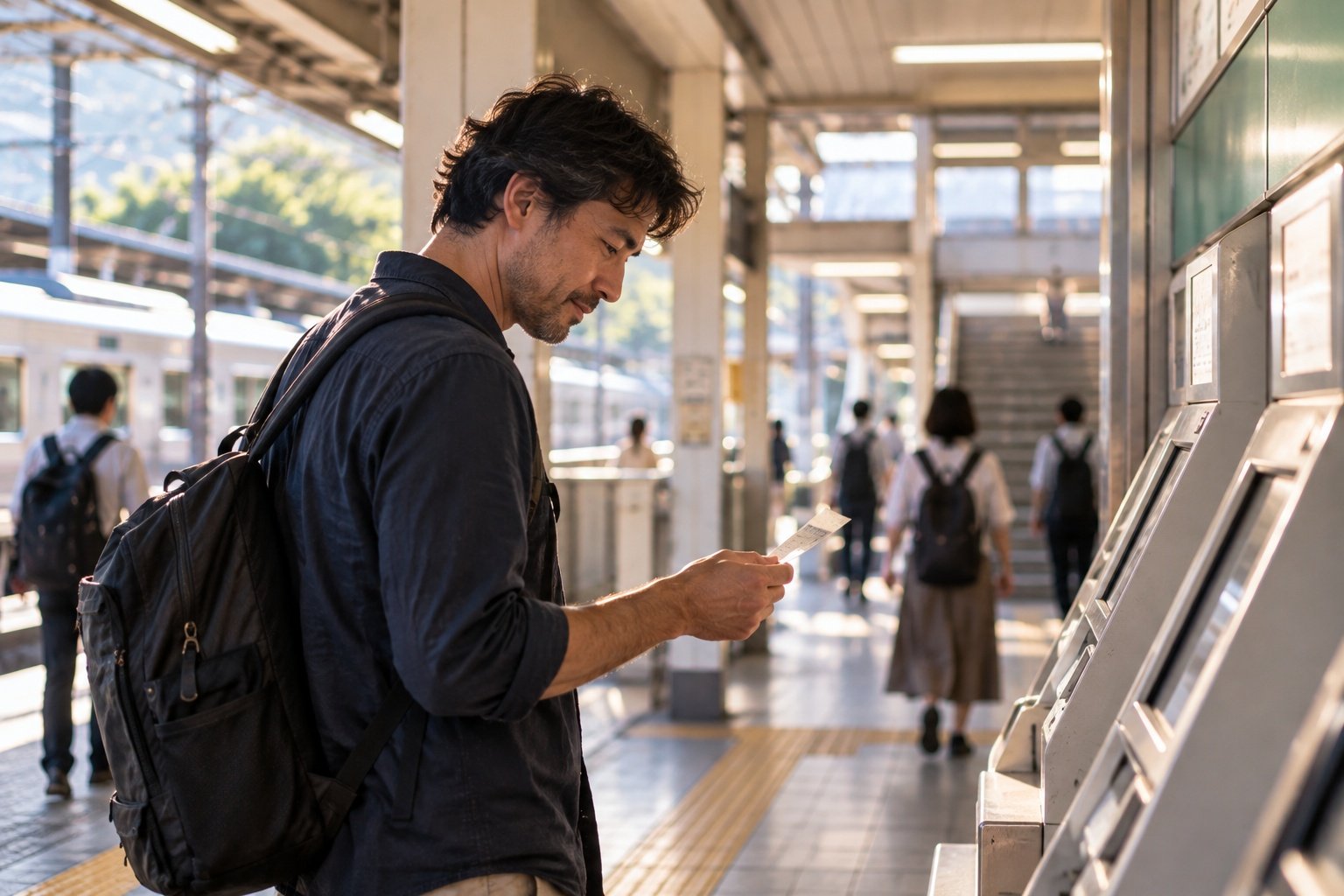

The platform already seems to know what everyone should do.
At many stations, people form lines near expected door positions and leave space for passengers to get off. Nobody gives each newcomer a private lecture. You watch, notice, and gradually move with everyone else.
Many everyday rules are learned with the eyes before they are explained with words.
Japan is sometimes described simply as a country of rules. Everyday railway life is more human than that: millions of people coordinate in limited space, imperfectly but repeatedly.
Movement depends on tiny moments of waiting.
A local train arrives. Doors open. People inside leave; people outside make space and then board. Twenty strangers perform a small piece of choreography nobody rehearsed together.
This is a useful place to understand まって—“wait”—and ちょっと まってください—“please wait a moment.”

つ becomes っ. Same family, different job.
Small っ is written like つ but visibly smaller. Size matters: the reader must immediately recognise that it is not the full kana つ.

See the size difference
Stroke order follows つ. The learning challenge here is not a new stroke pattern—it is recognising and writing the smaller size, then giving it the correct timing when you read.
Do not memorise translations. Learn what the words actually do.
A dictionary gloss gets you through the door. Usage tells you what room you have entered.
雑誌(ざっし) is a printed magazine. Hear the held consonant before し; do not add an audible “tsu.”
It can describe a small amount, ask for a brief wait, soften an interruption, or create conversational space. ちょっと… can even trail off when a direct answer would feel too sharp.
In いっしょに, it commonly means “together”: いっしょに いきましょう — “Let’s go together.”
Use it for doing something slowly or taking your time. It can carry a reassuring feeling: there is no need to hurry.
Context matters. A container can be full; there can be a lot of something. Do not lock it to one English word.
From まつ(待つ), “to wait.” まって alone can sound direct depending on the relationship; まってください is the useful polite request taught here.
A tiny word doing rather a lot of work.
ちょっと can mean “a little” or “a moment,” but real conversation gives it more jobs. It can soften an interruption, create a pause, or make a response less abrupt.
Please wait a moment. Here ちょっと describes a short amount of time and softens the request.
Later you will hear someone say simply ちょっと… and leave the rest unfinished. A beginner hears one word. A more experienced learner eventually discovers that the missing part may be exactly what everyone else understood.
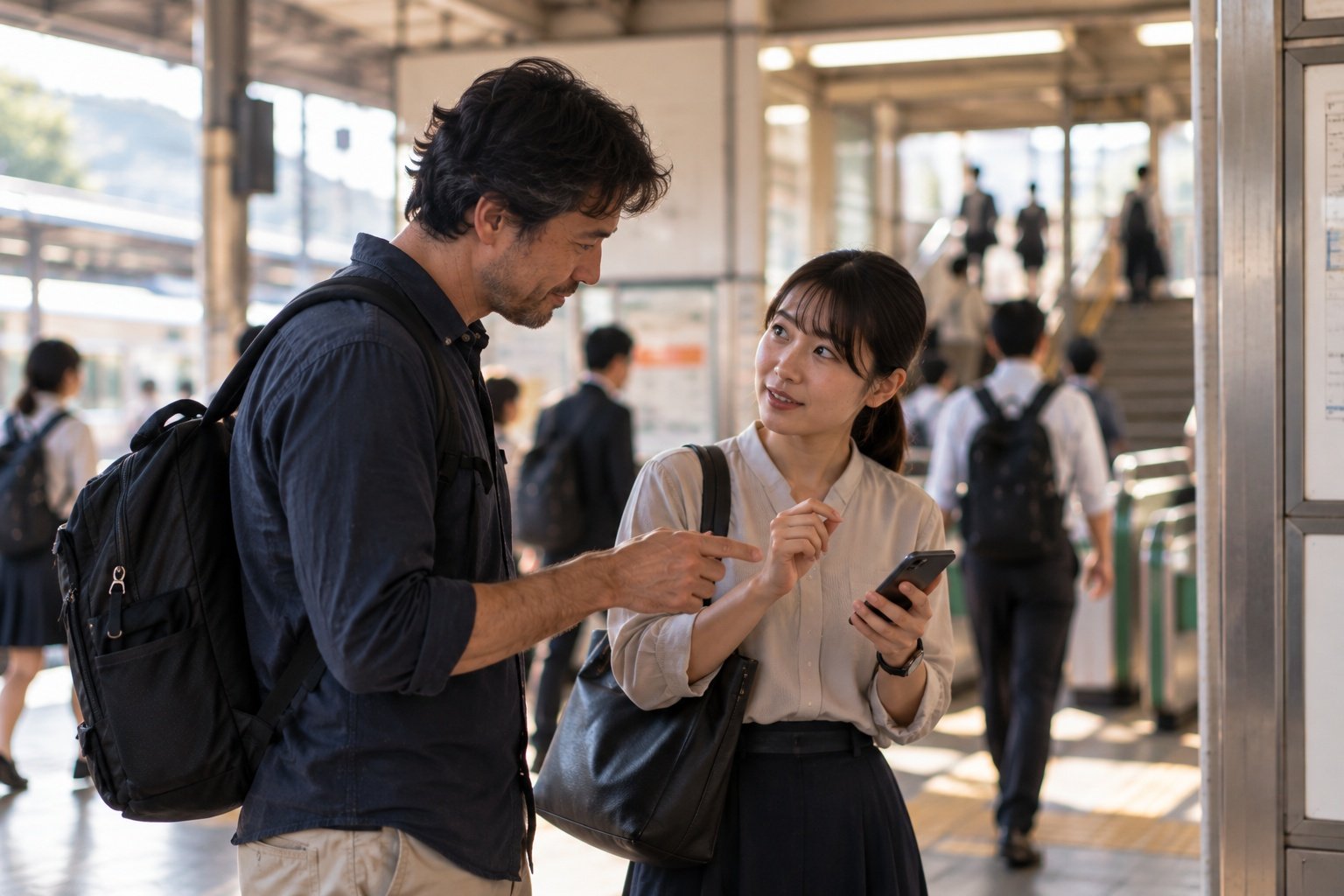
Finding the station.
The vocabulary matters because it helps one person reach another.
すみません is a natural way to open a polite request for attention; it is not only “sorry.” えき(駅) means station. いっしょに means together, and いきましょう is useful now as the whole expression “let’s go.”

For a few stops, strangers share a moving room.
Japanese trains are often described with a single word: quiet. Reality is more ordinary. Children make noise. Friends talk. Bags shift. Someone coughs. Someone falls asleep.
The more useful observation is that a carriage is shared space. People continually adjust to one another, just as they do in public transport everywhere—within local expectations that you learn partly by watching.
Meaning + situation + nuance.
The everyday word for a railway station. えきは どこですか asks where the station is.
A very common everyday word for electric trains. Railway terminology is more detailed than this, but beginners can use 電車 naturally in many ordinary travel situations.
つぎの でんしゃ means “the next train.” Notice の linking one noun idea to another.
Here it reassures: “It’s okay.” In other situations 大丈夫 can accept reassurance or indicate something is not needed, so context matters.
A natural acknowledgement that information or an instruction has been understood—not merely a vocabulary translation of “understood.”
In まってください, it helps form “please wait.” Do not assume ください maps mechanically to English “please” in every sentence; learn the whole pattern first.
A small question can prevent a surprisingly long detour.
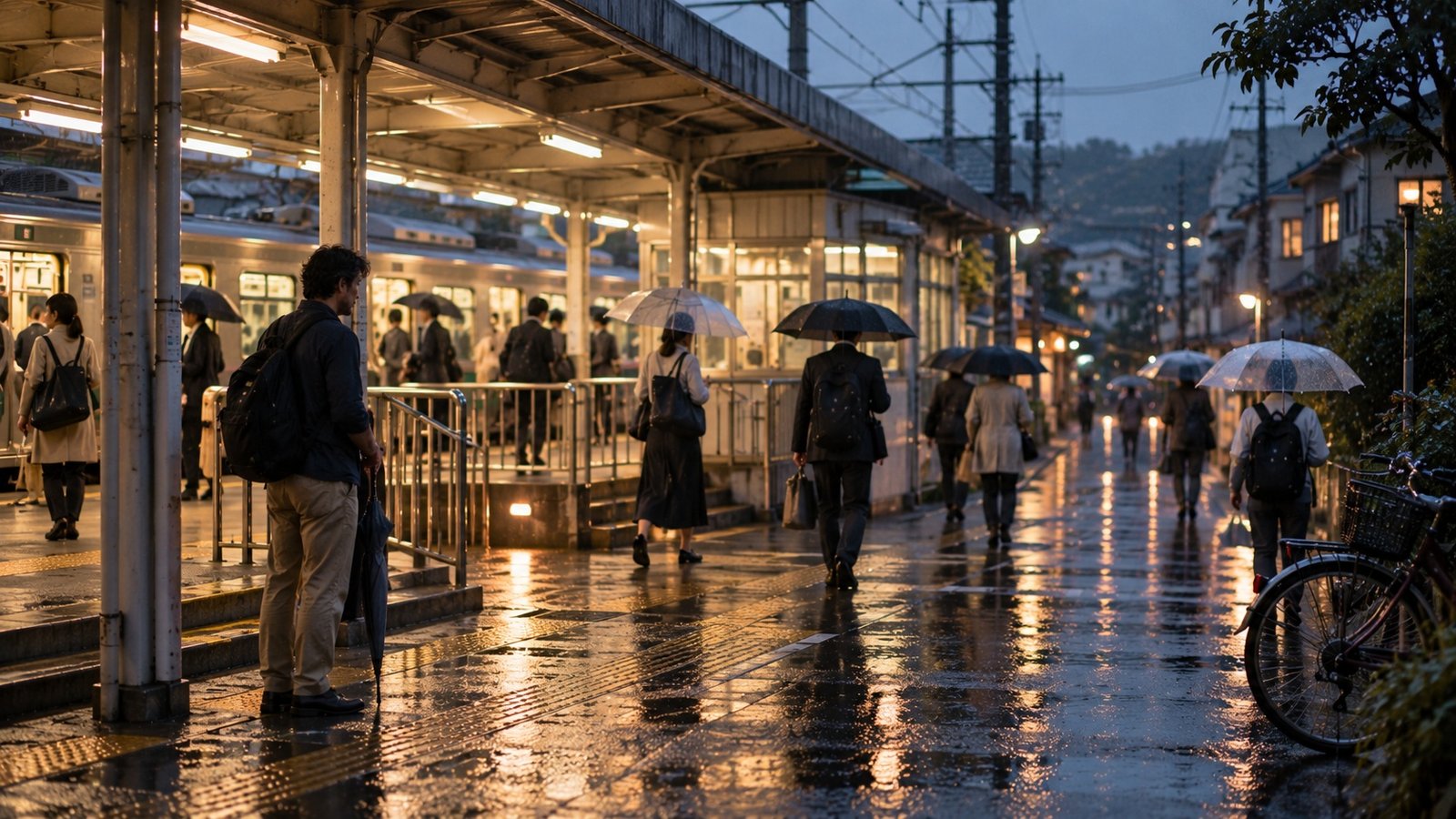
Listen for the silence inside the word.
Sound mission
When you hear きっぷ・ちょっと・いっしょ・ゆっくり, do not hunt for an audible “tsu.” Listen for the held consonant and the extra beat of timing.
Station mission
At an ordinary station, notice one thing people learn by observation: where they wait, how boarding flows, how shared space is negotiated. If you need help, begin with すみません.
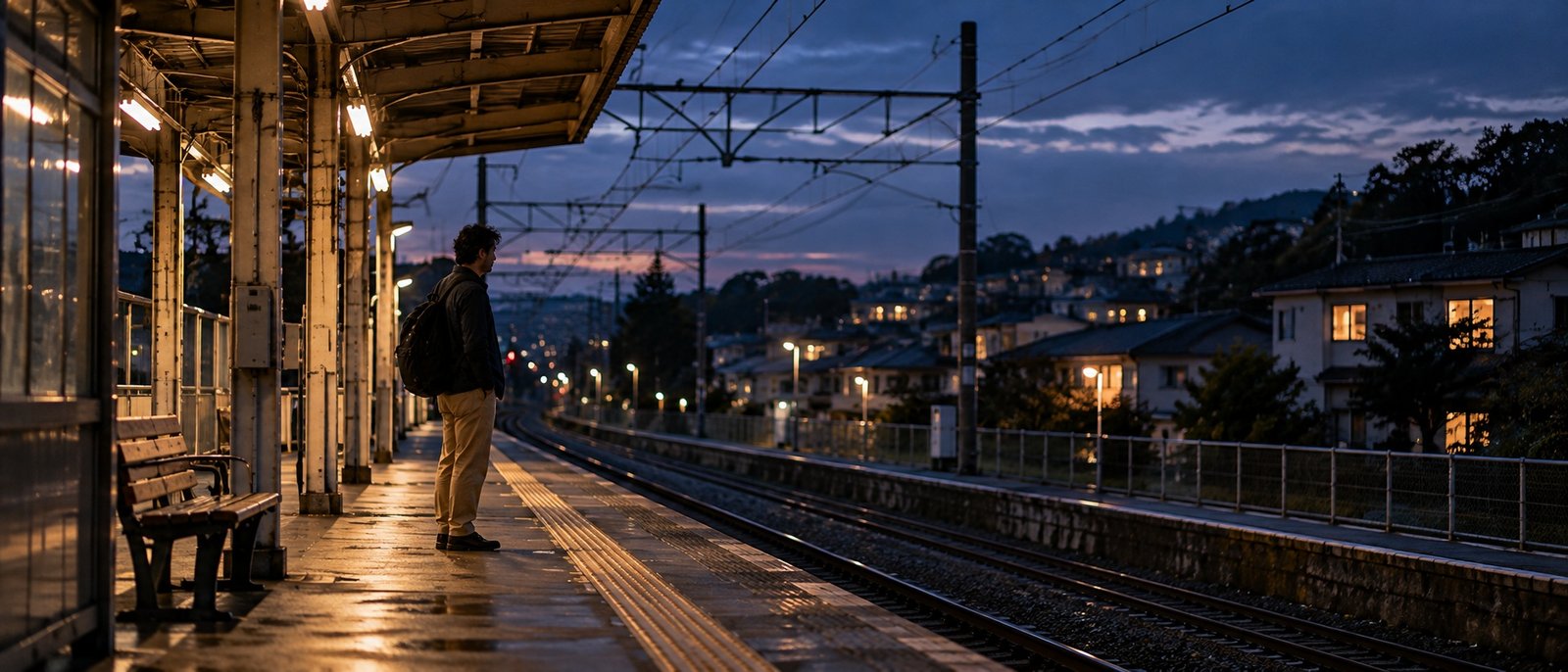
Trains move because they stop.
This morning, everyone seemed to know where they were going. You watched the platform. You followed the movement. You asked a question. Someone helped.
Somewhere along the way, Japanese gave you a character so small that beginners are tempted to hurry past it: っ.
The difference lives inside a moment of restraint. People board because others are allowed to leave. Conversations work because sometimes we wait.