Small Sounds.
Big Celebrations.
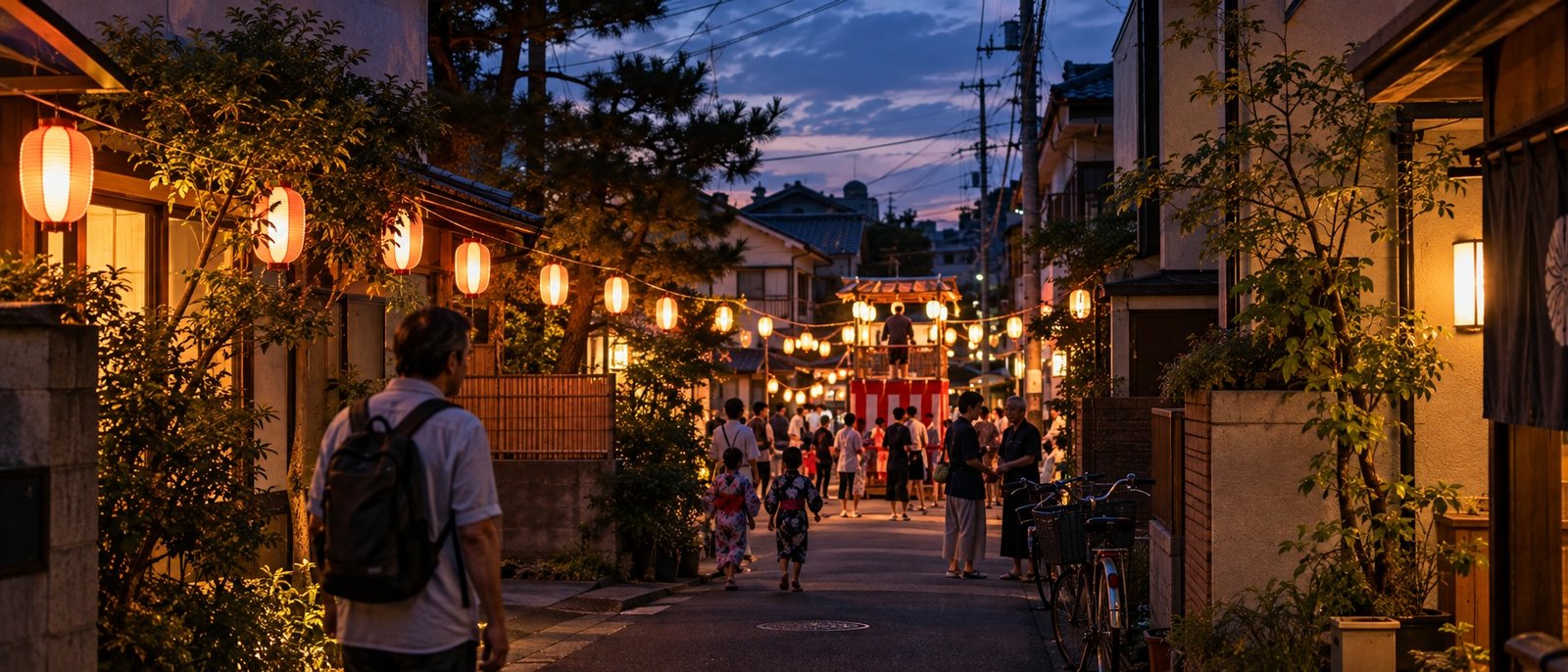
Not every possible Japanese sound gets equal work. These three are real, but uncommon—and that makes them useful teachers. Today they lead us into a summer evening where an ordinary neighbourhood street becomes a matsuri for a few bright hours.
One full ぴ. One small ゃ・ゅ・ょ.
You already know the yōon pattern. Keep ぴ full-sized, then write a smaller ゃ, ゅ or ょ. Read the pair as one blended beat—not as two separate kana.
Not ぴ・や. Blend it into one sound.
Not ぴ・ゆ. Keep the second kana small.
Not ぴ・よ. One compact sound.
These combinations exist, but they are not equally common in everyday vocabulary. Japanese is a living language, not a perfectly symmetrical kana exercise. Apparently language never received the memo about making textbooks tidy.
Japanese sometimes makes movement audible.
ぴょんぴょん can suggest hopping or bouncing. ぴゅーっと can evoke something moving quickly with a whoosh. These expressive words are part of the pleasure of Japanese: sound, movement and feeling often sit very close together.
English may say “the child hopped.” Japanese can sometimes make the sentence feel as if it hopped too.
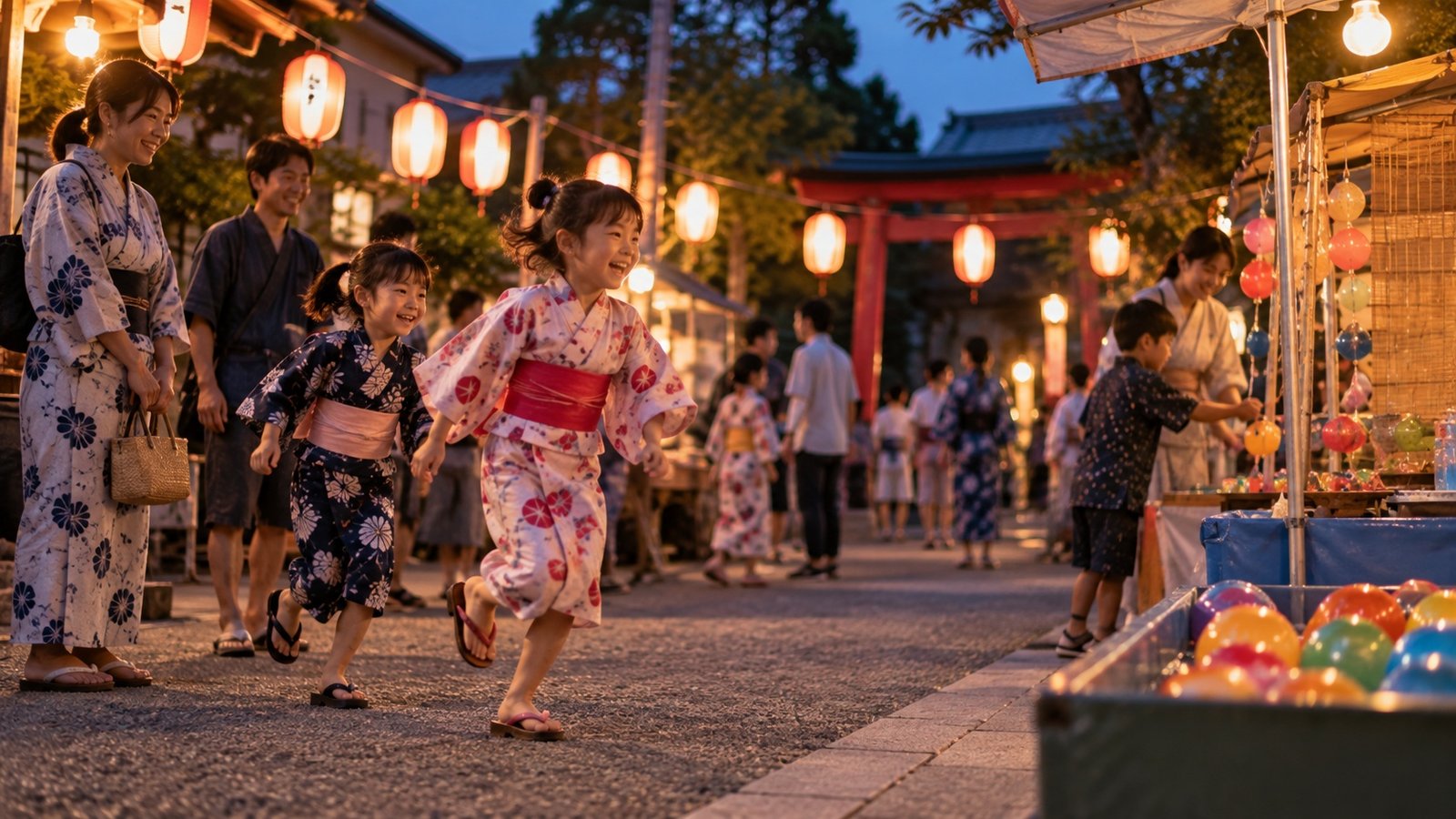
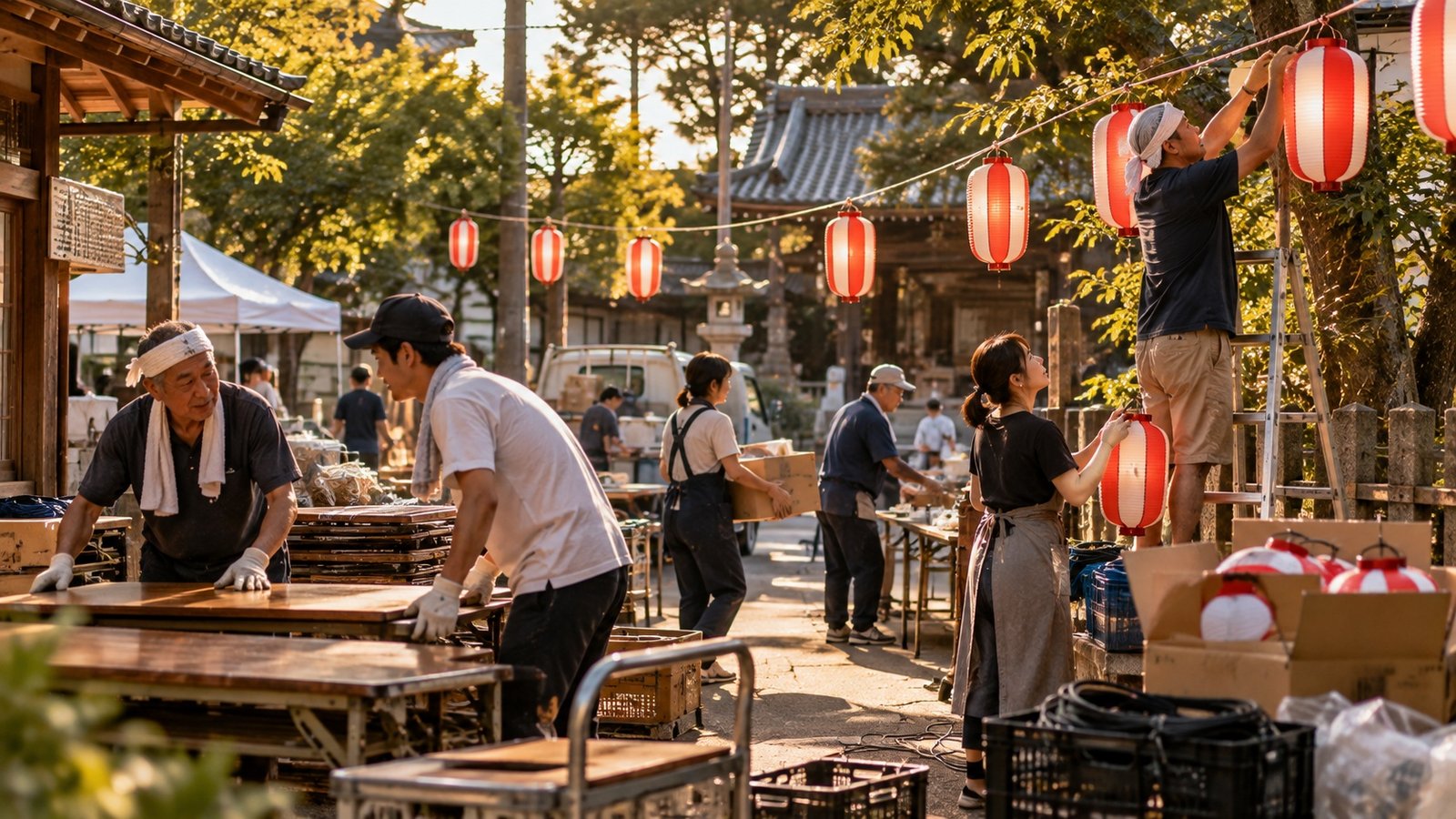
Festivals do not appear by magic.
Before the lanterns glow, somebody carries folding tables. Somebody checks the weather. Somebody discovers that the extension cable is, naturally, in the other storage room.
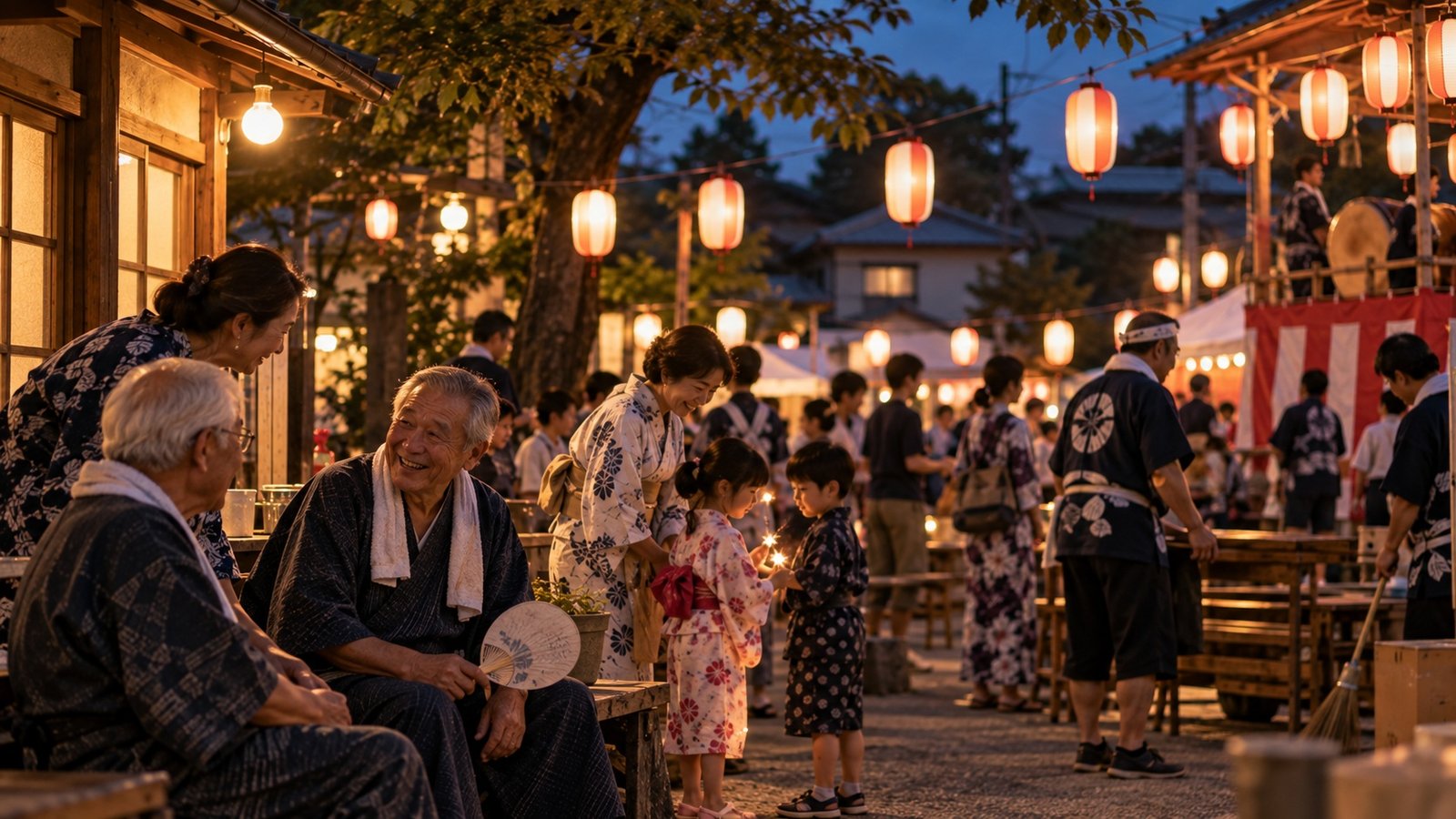
A neighbourhood 祭り(まつり) is not only a spectacle for visitors. It can also be community work: residents preparing, organising, cleaning and welcoming people into a shared evening.
The visitor sees lanterns. The organisers see seventeen things that still need doing.
Three useful words before the lights come on.
summer festival
light summer kimono, often seen at festivals, fireworks and onsen settings
traditional paper lantern
shiny, sparkling, gleaming

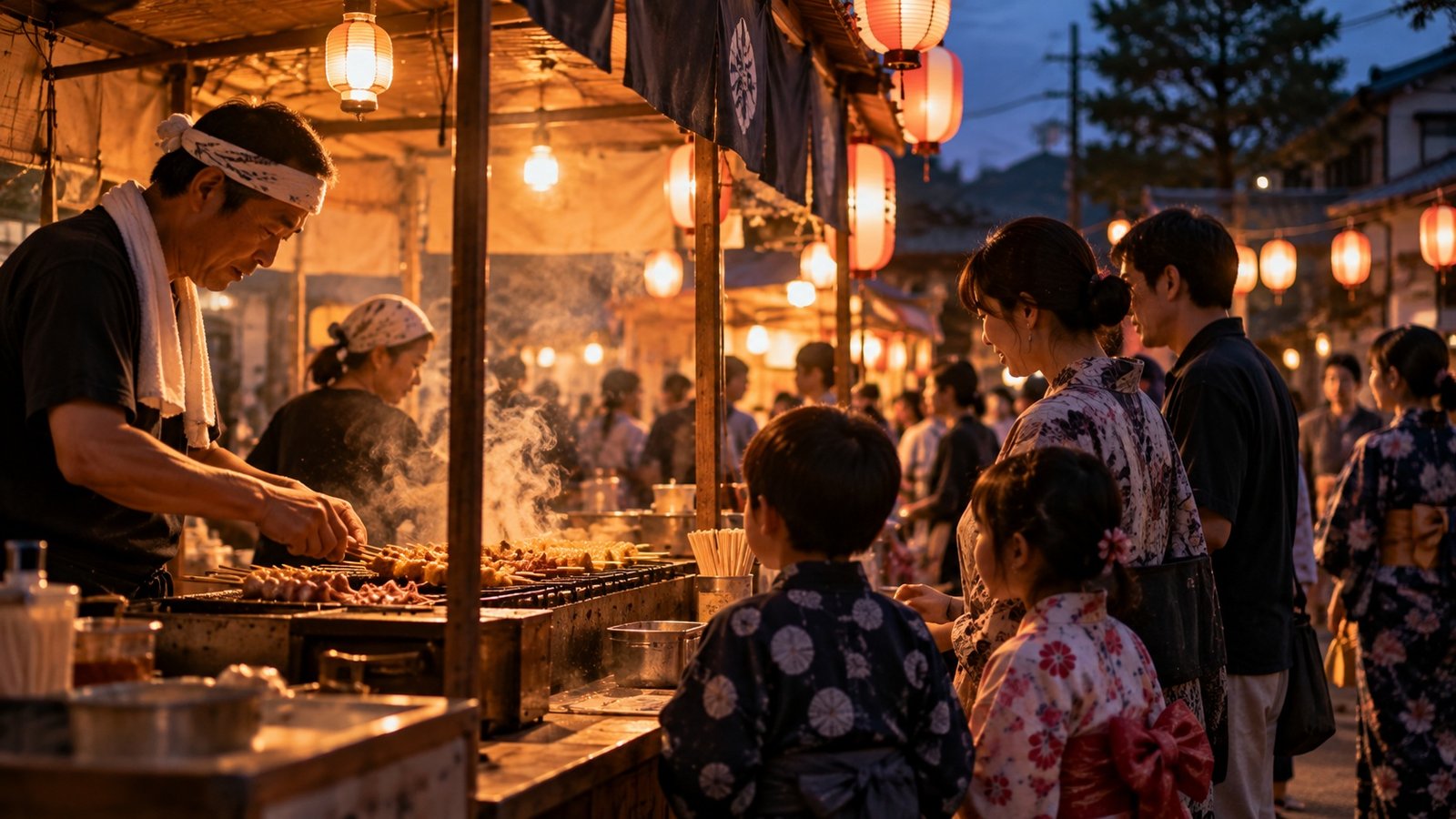
You may have arrived for culture. The grill has other plans.
Festival stalls—屋台(やたい)—are part of many matsuri memories: heat, steam, queues, children choosing treats and the dangerous moment when a smell persuades you that dinner number two is entirely reasonable.
What appears at a festival varies by place and event. The important lesson is not to memorize one “standard matsuri menu,” but to notice how food turns a public event into a shared sensory memory.
Make the second kana visibly smaller.
The small kana is not decoration. Its size changes how the pair is read. Watch the stroke order, then practise the full-sized ぴ followed by a smaller ゃ・ゅ・ょ.

Write ぴ at normal size. Then add the second kana smaller. The handakuten circle on ぴ stays exactly where it belongs.
Your first neighbourhood matsuri.
You do not need advanced Japanese to enter this moment. A few simple lines are enough to acknowledge what is happening and invite another person to speak.

Curiosity is useful Japanese.
When you do not know the name of something, これは なんですか。 is one of the most useful doors you can open.
Usually, ordinary people who keep showing up.
“Tradition” sounds like a grand museum word. In real neighbourhood life it may mean an older resident remembering where everything is stored, parents keeping an eye on children, younger volunteers carrying boxes, and people meeting neighbours they have not seen for months.
Culture survives through repetition. Repetition requires people.
Japan's festivals are highly diverse. Famous large festivals are only one part of the picture; shrine festivals, regional traditions and small community events can create very different experiences.
Rare sounds are still worth learning.
ぴゃ・ぴゅ・ぴょ are valid Japanese sound combinations, but you should not expect three neat columns of equally common beginner vocabulary. Some appear more readily in expressive language, names, borrowed forms or particular contexts than in a basic everyday word list.
That unevenness is useful knowledge. Learn to recognise and pronounce the sounds accurately—then spend your vocabulary energy where real Japanese gives you something worth remembering.
Notice what changes when a neighbourhood celebrates.
Before or during a local event
Look beyond the decorations. Who prepared the space? Who is helping children? Who is cooking, cleaning or guiding people? Try to notice the community behind the spectacle.
Use one small line
If the moment is appropriate, try おまつりですね, きれいですね or これは なんですか. You are not performing Japanese. You are using it to pay attention.

The lanterns come down.
The memory does not.
Tomorrow a bicycle will pass here again. Someone will hurry to work. A delivery van may stop where the food stall stood. The road will become wonderfully ordinary.
But tonight neighbours ate, laughed, worked, waited and watched their children. You began with three tiny sounds—ぴゃ・ぴゅ・ぴょ—and Japanese brought you into another evening you might otherwise have walked past.