Before You Enter,
Notice What People Do.
Three compact sounds take us somewhere unusually beautiful today: into the quiet space between an ordinary Japanese street and a place people treat with a little more care. We will learn じゃ・じゅ・じょ properly — and let them lead us into shrines, temples, everyday manners and the small human rituals that make places meaningful.

One sound. Not two hurried syllables.
You already know the pattern. Start with じ, then let a deliberately small ゃ・ゅ・ょ reshape it. The pair is spoken as one compact beat: じゃ · じゅ · じょ.
Do not stretch it into じ・や. Let the small ゃ pull the sound together.
The small ゅ changes the whole sound. Compact, smooth, one rhythmic unit.
Again, one combined sound. The small character is visually tiny but acoustically rather bossy.
If you can hear the difference between じ・や and じゃ, you are already doing the important work. Accuracy grows from noticing first, speed later.
神社
じんじゃ · Shinto shrine
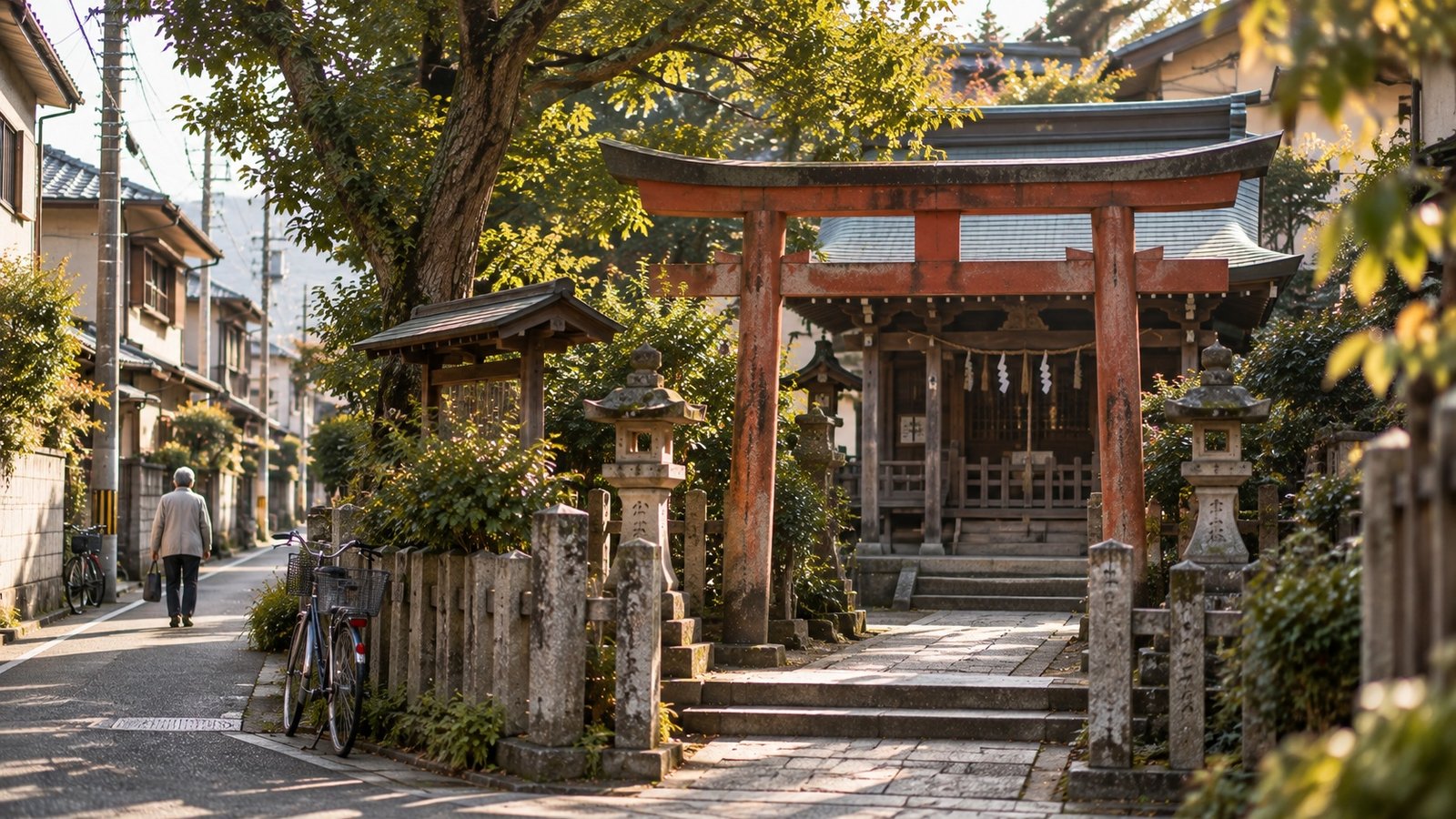
You may find one beside a busy road, behind an apartment block, at the foot of a mountain, or quietly occupying a corner you have walked past twenty times. Japan has a habit of placing the sacred surprisingly close to the ordinary.
Kanji is exposure here, not a reading test. Your job today is to recognise the spoken word じんじゃ.
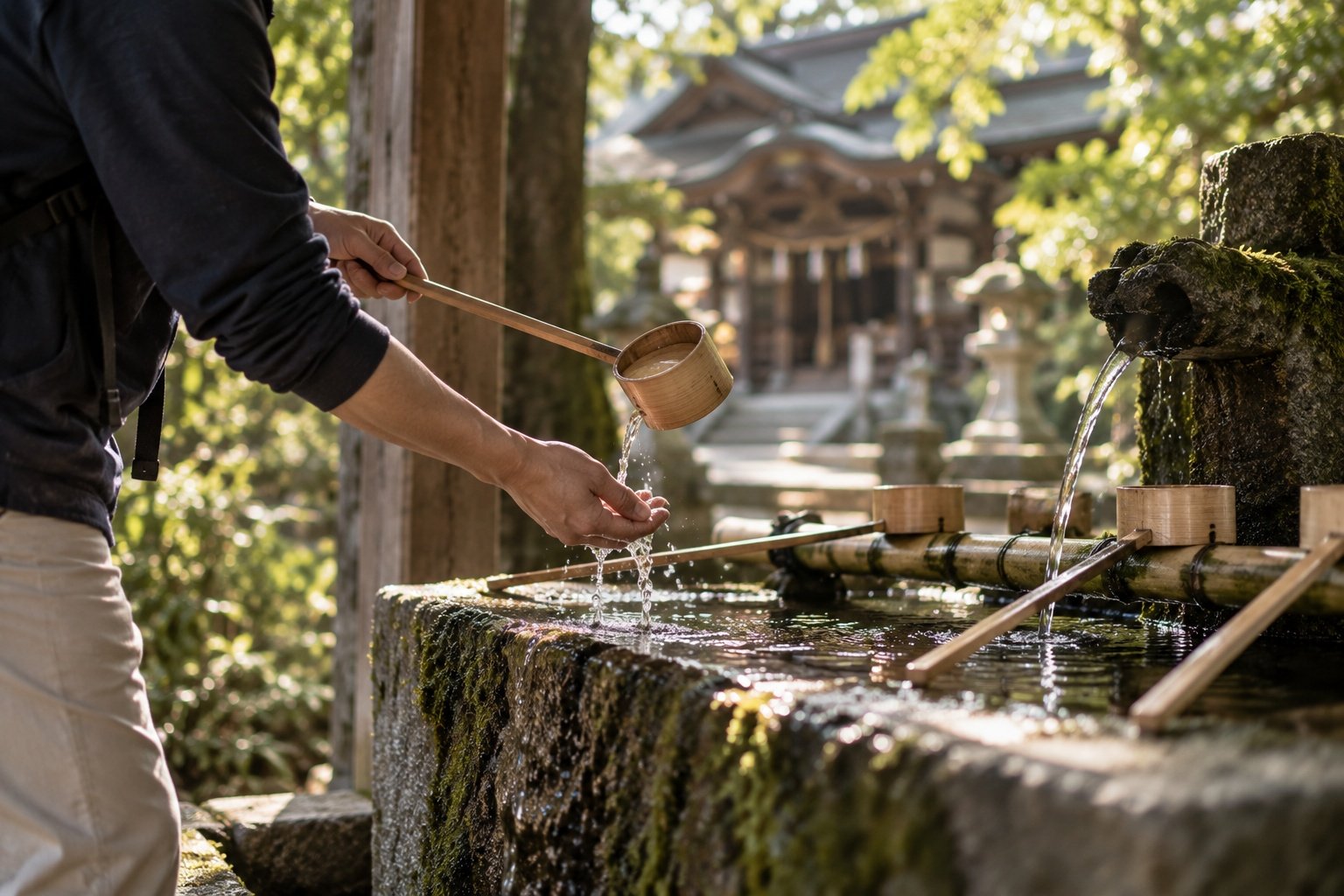
A little water. A little attention.
At many shrines, visitors encounter a purification basin before approaching the main sacred area. The exact arrangement and practice can vary, but the larger idea is easy to feel: pause, prepare, and enter with attention.
“A small act says: I have arrived somewhere that deserves my attention.”
Nobody is grading the spiritual quality of your handwashing. The gesture matters because attention matters. That is a useful cultural lesson far beyond the basin itself.
For a few seconds, an ordinary day becomes still.
お参り(おまいり) is a useful word for visiting a shrine or temple to pay respects or pray. At many Shinto shrines you may see a familiar bowing-and-clapping pattern. Traditions can differ, so treat what you observe at the particular shrine with respect rather than assuming every sacred place follows one universal script.
Clapping is associated with Shinto shrine worship; it is generally not the normal prayer practice at Buddhist temples. One small observation already helps “beautiful old Japanese building” become several different worlds.
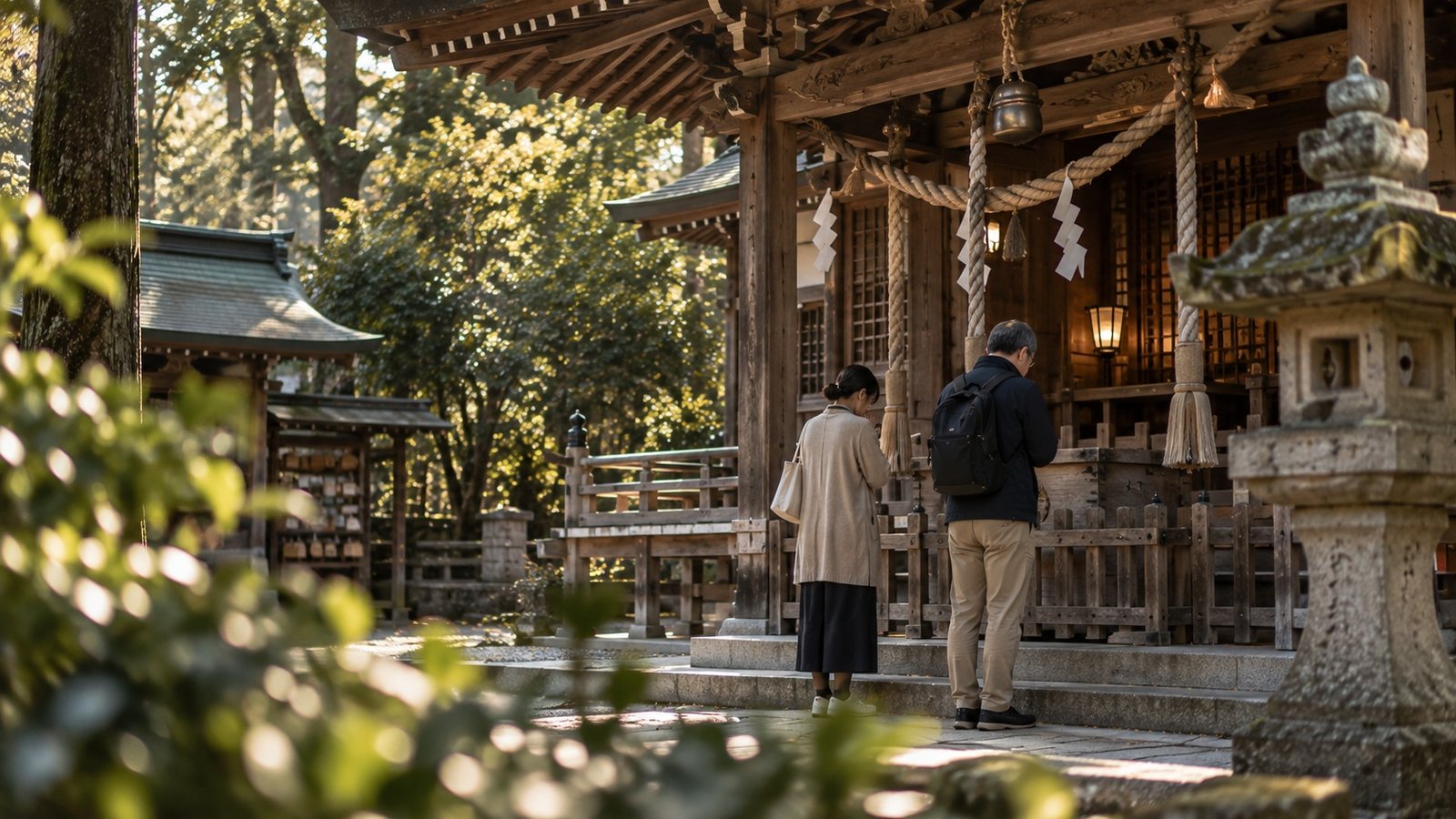
They are not two words for the same thing.
A 神社(じんじゃ) is a Shinto shrine. An お寺(おてら) is a Buddhist temple. Japanese history brought Shinto and Buddhism into long, complicated contact, but the spaces, traditions and forms of worship are not simply interchangeable.
じんじゃ · Shinto shrine
A torii commonly marks entry into shrine space. Shinto worship, kami and shrine-specific customs belong here.
おてら · Buddhist temple
Temple gates, Buddhist halls, images, incense, bells and Buddhist practices belong to a different religious tradition.
A torii does not mean “generic beautiful Japanese religious place.” Learning to notice the difference is one small way of seeing Japan more carefully.

Small ゃ・ゅ・ょ. Big responsibility.
The second kana is deliberately smaller. That visual difference tells the reader that the two characters form one combined sound. Here you can watch the strokes build in order — not merely stare at a finished character and hope enlightenment occurs.

The source kana や・ゆ・よ are rendered smaller here to demonstrate yōon proportions. Write the second kana clearly smaller than じ.
住職
じゅうしょく · Buddhist temple priest
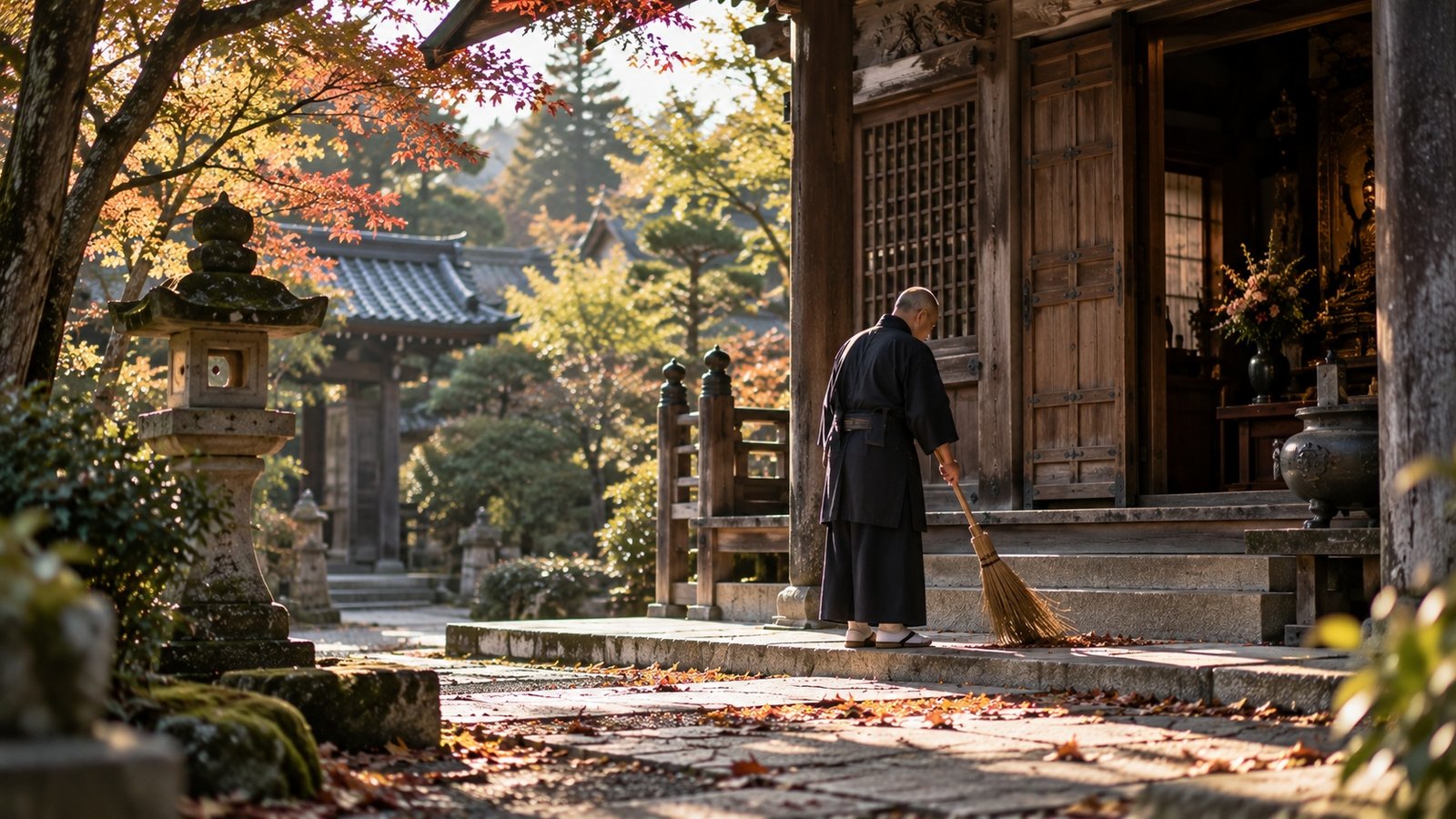
It is easy to photograph a temple as if it has been standing perfectly still for six hundred years waiting for your camera. Real places are less cooperative. Doors are opened. Flowers are arranged. Leaves fall with complete disregard for cultural heritage.
Centuries of history are magnificent. Unfortunately, the leaves still need sweeping.
住職(じゅうしょく) commonly refers to the resident/head priest of a Buddhist temple. For us today, it also opens a more human window: traditions survive because people continue to care for places, objects, ceremonies and communities.
Let the sounds find somewhere to live.
Shinto shrine. Sacred space can sit surprisingly close to ordinary neighbourhood life.
Buddhist temple priest. A reminder that culture is maintained by actual people with actual mornings.
Order; turn. At clinics, counters, bakeries and busy restaurants, this word is wonderfully unglamorous and extremely useful.
Skillful; good at something. A word that may arrive suspiciously early in your Japanese-learning career.
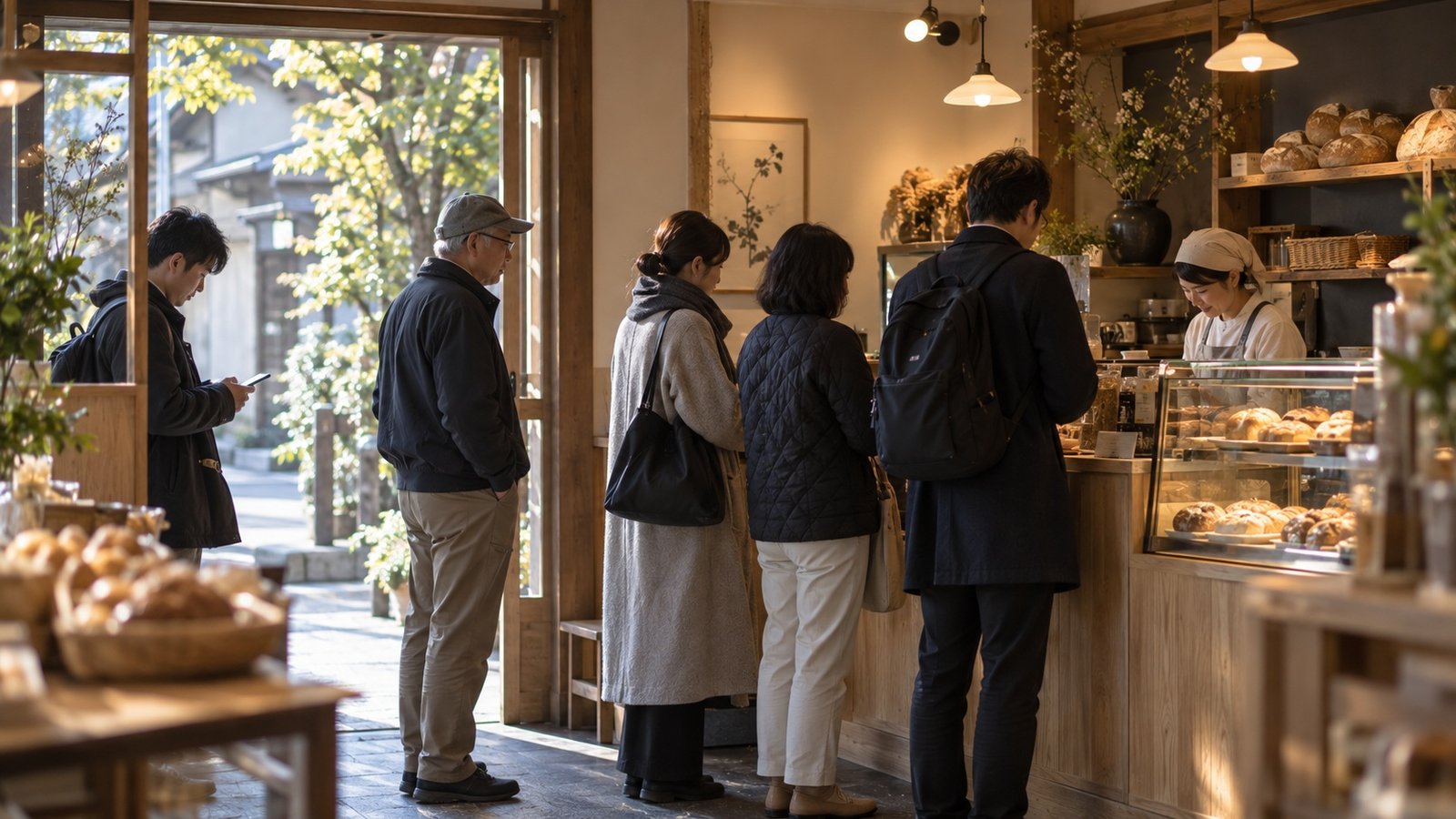
順番 — eventually, everybody waits.
じゅんばん means order or turn. You may encounter the idea at a clinic, bakery, public counter, school, restaurant or anywhere people need to know who comes next.
After shrines, temples and centuries of tradition, Japanese returns us to the eternal human experience of waiting our turn.
じゅんばんを まちます。
Wait for your turn.
Sometimes the wait is two minutes. Sometimes the ramen has apparently acquired sufficient cultural importance to justify twenty-five. Either way, the language is useful.
Four lines. No cultural lecture required.
A visitor is standing near a shrine entrance and checks what the place is before going farther. The grammar stretches slightly beyond today's target; that is fine. At this stage, understand the situation and hear how the language behaves.
ここ = here. ~ですか turns the statement into a polite question. ~てもいいですか asks whether doing something is okay. You do not need to master that grammar today; recognising the whole phrase is enough.
日本語が上手ですね。
にほんごが じょうずですね。 — “Your Japanese is good, isn't it / Your Japanese is good.” You may hear this after a genuinely impressive conversation. You may also hear it after successfully producing こんにちは without causing structural damage to the language.
Accept the kindness. We are not opening the champagne just yet.
A modest response you may hear is まだまだです — roughly, “I still have a long way to go.” Japanese interactions often make room for modesty after praise. You do not have to reject every compliment, but it is useful to recognise the social rhythm.
Do not chase speed. Chase shape.
Say each pair slowly. Keep the second kana small in your mind as well as on paper. Then attach the sound to a real word.
じゃ → じんじゃ
じゅ → じゅんばん / じゅうしょく
じょ → じょうず
Notice the entrance before the building.
If you encounter a shrine
Pause before reaching for the camera. Look for the transition from street to sacred space. Notice the torii, water basin if present, how local visitors move, and where they slow down.
Your language mission: quietly recognise or say じんじゃ.
If you encounter a temple
Look for what differs: gate, halls, incense, bells, Buddhist imagery, the way people pray. Do not worry about becoming an expert in five minutes. Curiosity is allowed to be gradual.
Your culture mission: stop calling every traditional sacred building a shrine.
Perhaps nobody will explain any of this when you first visit. An elderly neighbour bows. Someone rinses their hands. A child copies a parent. A priest sweeps fallen leaves. You may understand only a few words. That does not mean Japan is closed to you. It means you have begun learning how to notice it.
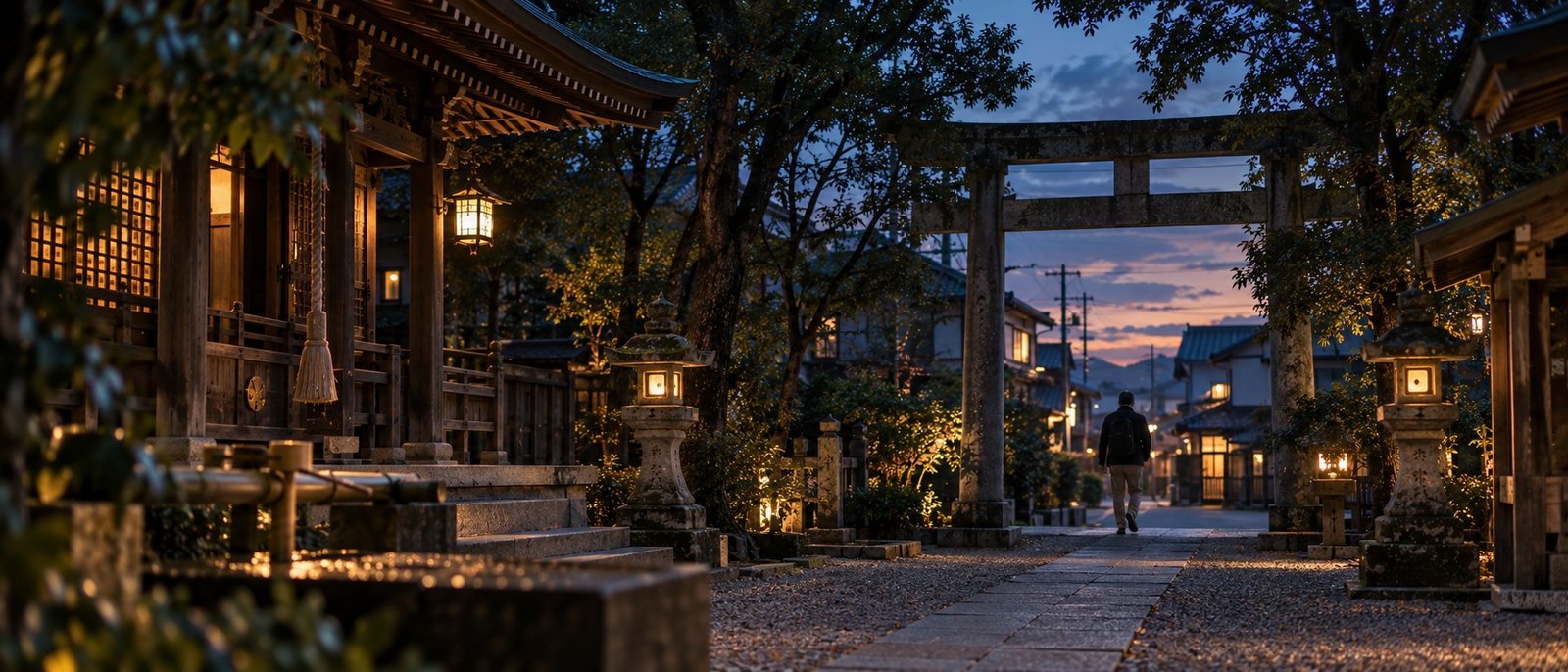
The place has not changed.
You have learned to see it differently.
You arrived learning three sounds: じゃ・じゅ・じょ. You leave knowing that じんじゃ is more than a vocabulary item, that shrine and temple are not interchangeable, that a small ritual can carry a reason, and that the people who sweep, prepare, visit, wait, bow, pray and continue ordinary life are part of the culture too.
Tomorrow one of these sounds may appear on a street, in a conversation, at a clinic, beside a torii, or in a compliment you are not entirely sure you have earned.