おはようございます。
Good morning.
A polite morning greeting. Natural with neighbours, colleagues, hotel staff and people you meet at the beginning of the day.
Your first useful Japanese for real life — enough to greet someone, ask, recover when you don't understand, and thank the person who waited.
Today, we follow one ordinary day in Japan. No exam. No heroic fluency. Just small words becoming useful.
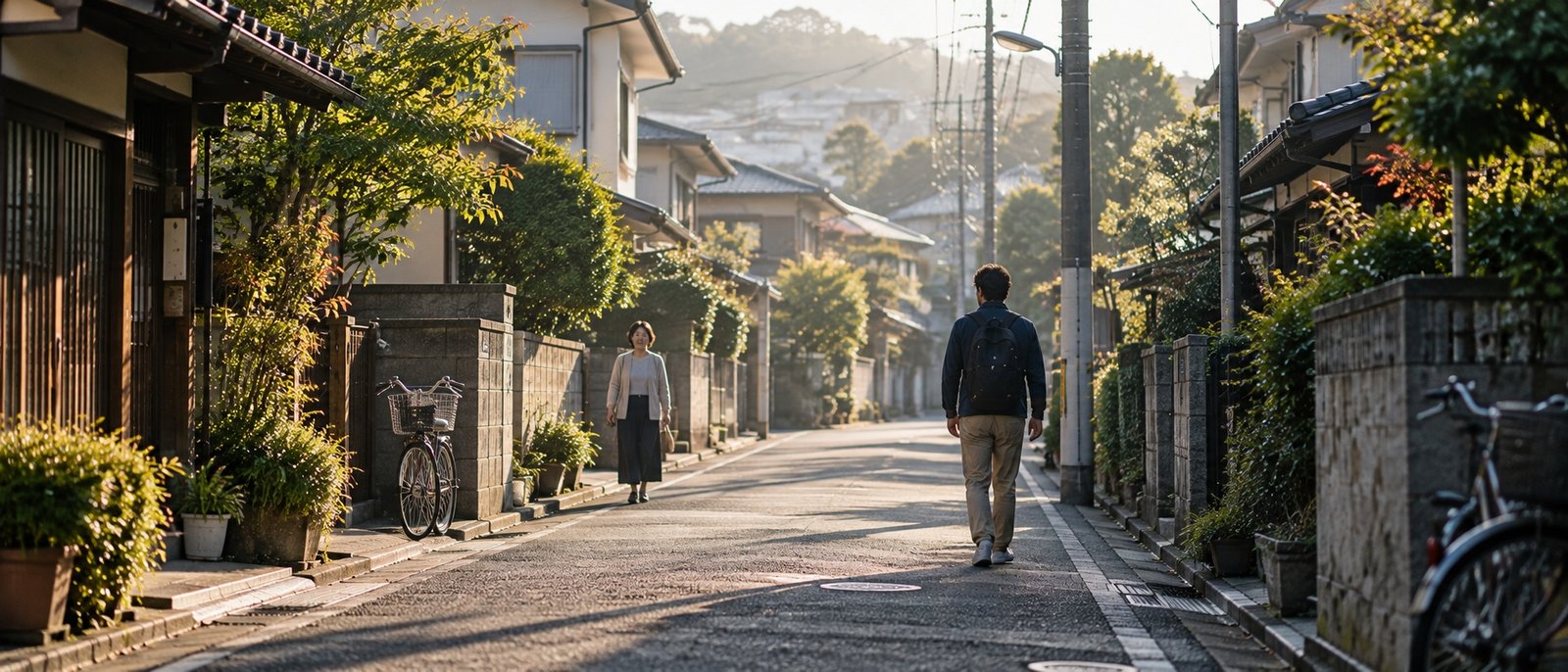
You do not need to read hiragana before using this page. Listen first. Notice the situation. Say what you can. Understanding the machinery can come after the door has opened.
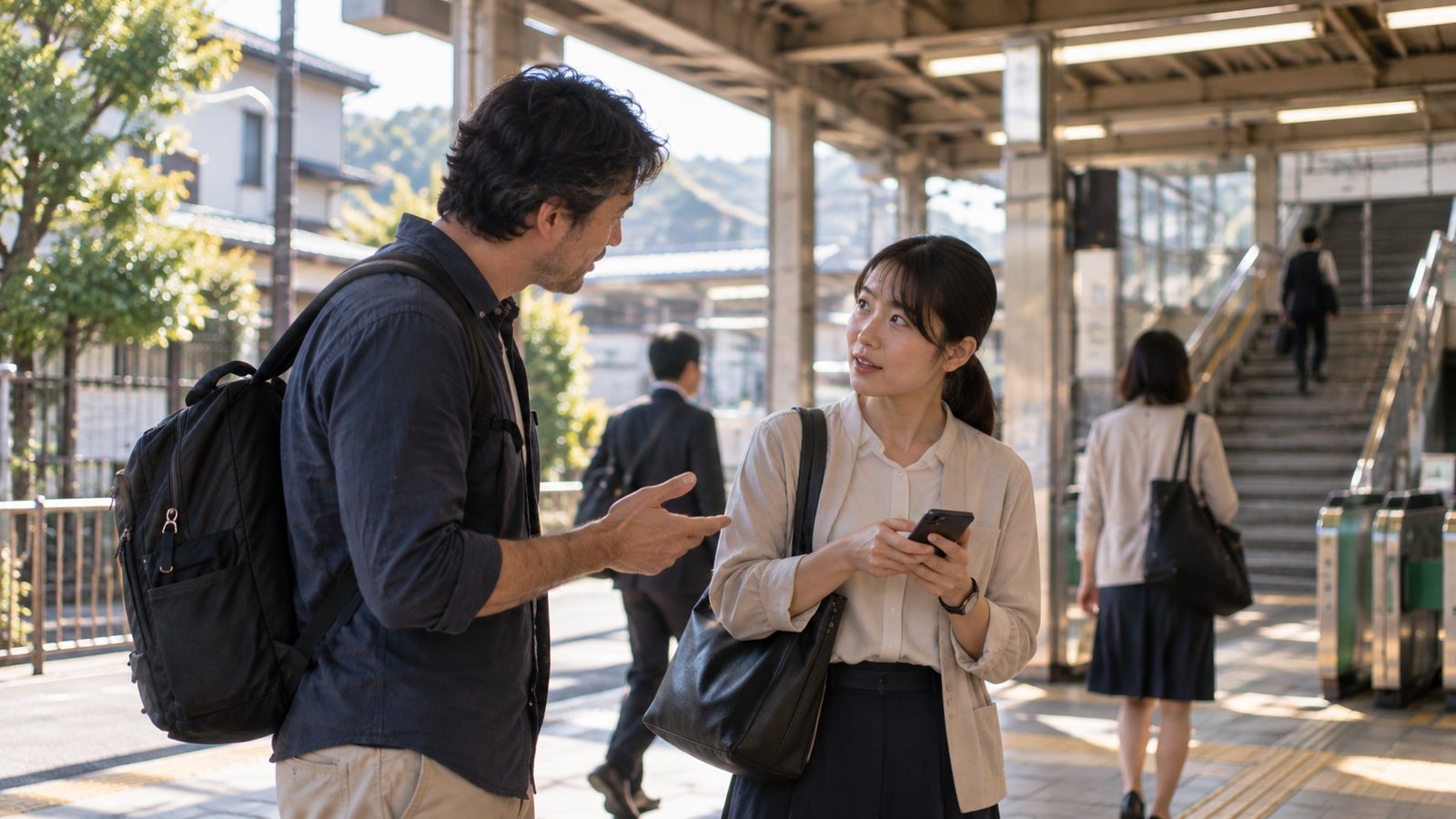
Use すみません to get someone's attention before a question, to make a small apology, or sometimes to acknowledge that another person has gone to some trouble for you.
Do not worry about choosing a perfect English translation. Watch what is happening between the people.

これ means “this.” おねがいします frames the request politely. Pointing plus this sentence can carry you surprisingly far in a café, shop, ticket counter or reception desk.
ください is another important request expression. You will hear and use both, but they are not simply two interchangeable stickers meaning “please.”

If a staff member offers something optional and you answer だいじょうぶです, context and gesture may make it mean “I'm fine without it.” In another situation it can reassure someone that everything is all right.
Japanese often asks you to understand the scene, not merely translate the sentence.

You successfully asked a question in Japanese. Excellent.
Unfortunately, the other person has now answered it — also in Japanese.
Do not abandon the conversation. わかりません is useful Japanese too. It tells the other person exactly what needs to happen next.

These expressions change the job from “understand everything” to “keep the exchange alive.” That is a much more reasonable first-day objective.
These are not flashcards floating outside real life. Each expression has a job, a situation and a human consequence.
A polite morning greeting. Natural with neighbours, colleagues, hotel staff and people you meet at the beginning of the day.
One of the most useful doorways into a Japanese interaction. It can get attention, soften an interruption, apologise, and sometimes acknowledge the trouble someone took for you.
Useful when making a request or entrusting something to another person. It is more than simply attaching the English word “please” to a sentence.
A wonderfully practical beginner sentence when pointing to an item, ticket, dish or option.
The direct word for “no,” although everyday Japanese often softens refusals through context rather than relying on いいえ alone.
A high-value expression whose meaning comes partly from the situation. Listen to the person, look at what is being offered, and do not translate it mechanically as “yes.”
A complete, useful sentence. Saying this is not failure; it is how you keep the conversation alive.
Use this when you need the speaker to repeat what they said.
Useful when you can understand some Japanese but the speed is defeating you.
これは points to “this”; なんですか asks what it is. A tiny pattern that opens a surprising amount of everyday Japan.
A compact question for finding places. Add the place before は to ask where a particular thing is.
Reserve this for a genuine need for help rather than every small uncertainty. ください turns the request into “please help.”
A phrasebook can quietly pretend that conversation ends after your sentence. Real Japan is less cooperative.

Someone pointed toward the right platform. A staff member waited while you found the words. A stranger repeated something more slowly.
These are tiny encounters. They are also where a language begins becoming part of your actual life.

None of this means every Japanese interaction follows one timeless etiquette rule. Age, workplace, region, relationship and generation matter. What you are learning first is simpler: listen to the words, but also notice what the people are doing with them.
Before a simple question, try すみません。 Notice how naturally it creates a moment for the other person to respond.
After receiving ordinary help or service, use ありがとうございます。 The event does not need to be dramatic to deserve acknowledgement.
If the answer comes too quickly, try ゆっくり おねがいします。 before switching languages. Give the conversation one more chance.

This morning, Japan was full of conversations happening without you.
Now you can interrupt one politely. Ask a question. Admit that you didn't understand the answer. Ask again. Thank the person who waited.
That may not sound like much Japanese.
It is enough to begin.
Next destination: Getting Around Japan will build on these first expressions for stations, trains, directions and movement. Until that route is live, continue with the Foundation lessons from the main learning path.