ひゃ・ひゅ・ひょ
A small ゃ・ゅ・ょ. Three small sounds. A little more of Japan becomes audible.
You already know ひ and the small yōon kana. Now hear what happens when they meet—and connect the new rhythm to money, everyday choices and even the sound of winter wind.

Do not read these as two separate kana. ひゃ・ひゅ・ひょ are each one combined sound.
Full-size や is not small ゃ.
Size changes the rhythm. A full-size や begins another beat. A small ゃ joins the sound before it.
First hear them apart. Then hear the combined sound.
The small ゅ does not start a separate syllable.
Keep the movement compact and connected.
ひゃく enters everyday life.
ひゃく means one hundred. You will hear it constantly in Japan—in prices, quantities and ordinary transactions.
ひゃくえん means 100 yen. Do not memorize it as an isolated vocabulary item. Notice the change: ひゃ, which began as a sound on the page, is now something you can recognize in a real Japanese transaction.

Don't learn only the translation.
A basic number that quickly becomes part of real life—money, counts, addresses and quantities. Today it also gives you a very practical home for the sound ひゃ.
You may hear this while buying an inexpensive everyday item. The familiar world of 100-yen shops also gives ひゃ an easy real-life anchor in Japan.
Here the important lesson is the sound pattern itself. Japanese has different words read ひょう, so context—not sound alone—tells you the meaning.
When used as 表紙, ひょうし is the outer cover of a book, notebook or magazine—the face you see before opening it.
評判 is useful when people talk about a restaurant, shop, product or person. A place can have a good reputation because people have heard good things about it.
Japanese often turns sensation into language. ひゅうひゅう can evoke wind blowing or whistling—language that lets you almost hear the scene.
Japanese becomes useful at the counter.
You do not need every grammar detail yet. Follow the human moment: the staff gives the price, the customer checks what they heard, and then decides to buy.

ひょうばん · reputation
Imagine someone telling you that a neighbourhood bakery, restaurant or shop is well regarded. ひょうばん is about the reputation something has among people—not a star rating on a screen, but the broader idea of what is being said or thought about it.
Later you will meet phrases such as ひょうばんが いい—“it has a good reputation.” For now, simply connect the sound ひょ to a word that belongs in real conversations about Japan.

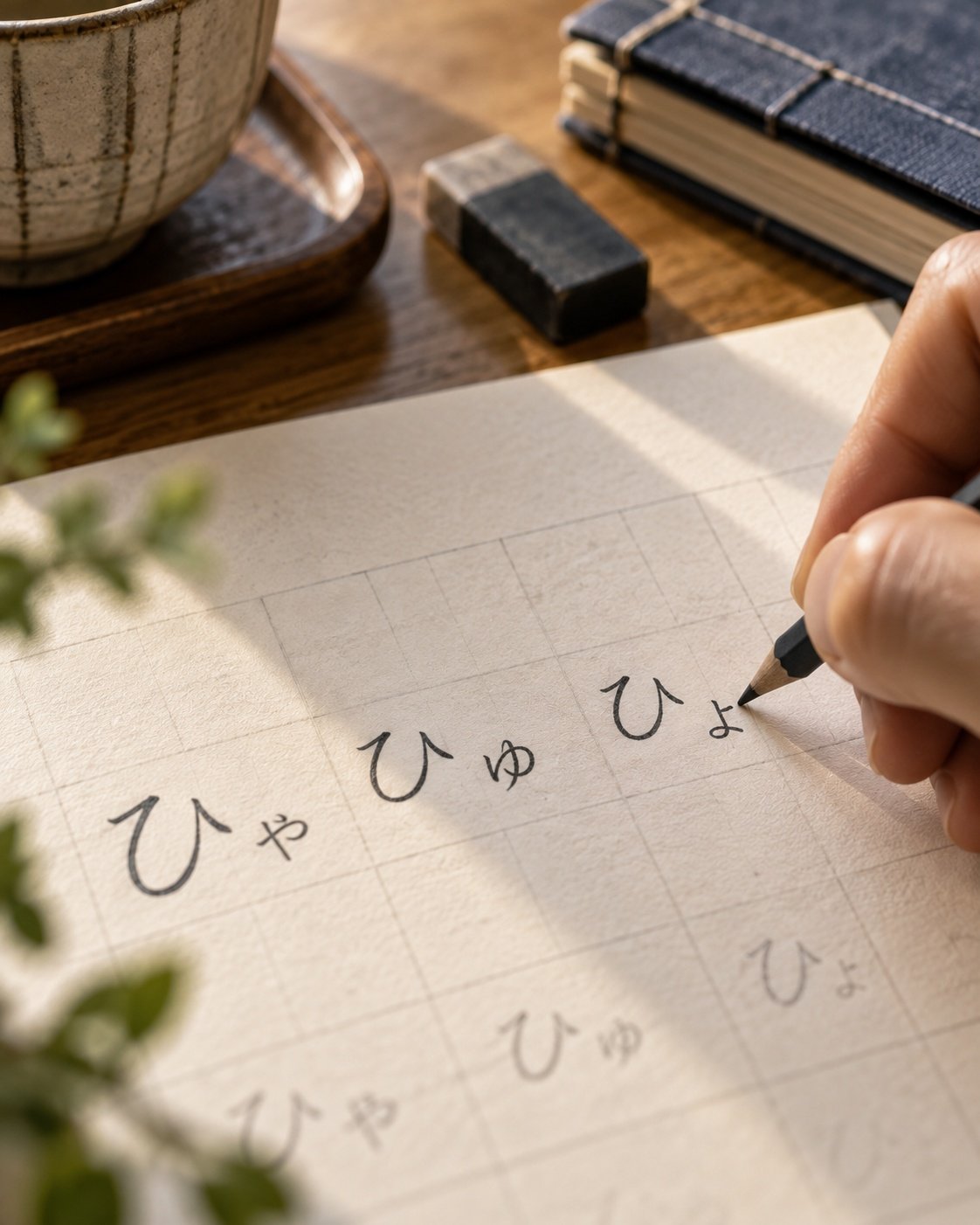
Write ひ first. Then add a smaller kana.
Choose ひゃ・ひゅ・ひょ. Watch every stroke in order. The second kana is written visibly smaller, but the pair is read together as one combined sound.
Write ひ first. Then write a visibly smaller や beside it. The pair is read together.
ひゅうひゅう
On a cold day, Japanese can describe wind with a word that itself feels windy. ひゅうひゅう is sound-symbolic language: it can suggest wind whistling or blowing strongly.
This is an important doorway into Japanese. Mimetic and sound-symbolic expressions are not decorative curiosities; they are a lively part of everyday expression.

Six sounds and words. One small piece of real Japan.
The recording contains all six items above. Listen once without looking; then play it again and follow each item.

Three unfamiliar sounds now belong to things you can notice in Japan.
ひゃ can live in a price. ひょ can live in what people say about a place. ひゅ can live in the sound of winter wind. That is how kana stops being a chart and begins becoming Japanese.